Showing posts with label gravitational potential energy. Show all posts

Monday, February 3, 2020

Chapter 8.17 - Energy of an Orbiting Satellite

In the previous sectionwe completed a discussion on speed and time period of earth satellites
• In this section we will see energy of an orbiting satellite

1. A satellite will always be at a constant height h from the surface of the earth. So it will be having a constant potential energy
• We know that, this potential energy is given by $\mathbf\small{U=-\frac{G\,M_E\,m}{(R_E+h)}}$
2. But the satellite is in constant motion also. It has a constant speed V
• So it will have a kinetic energy of $\mathbf\small{\frac{1}{2}m\,V^2}$ 
3. In the previous section we saw Eq.8.22: $\mathbf\small{V=\sqrt{\frac{G\,M_E}{(R_E+h)}}}$
• So the kinetic energy will be given by: $\mathbf\small{K=\frac{1}{2}m\,\left(\sqrt{\frac{G\,M_E}{(R_E+h)}}\right)^2}$
• Thus we get Eq.8.28: $\mathbf\small{K=\frac{1}{2}\frac{G\,M_E\,m}{(R_E+h)}}$
4. If we add the results in (2) and (3), we will get the total energy E
• That is., E = U + K
• So we can write Eq.8.29: $\mathbf\small{E=-\frac{G\,M_E\,m}{(R_E+h)}+\frac{1}{2}\frac{G\,M_E\,m}{(R_E+h)}}$
5. We see that, on the right side there are some common items
• If we put $\mathbf\small{X=\frac{G\,M_E\,m}{(R_E+h)}}$, we will get:
Eq.8.30: $\mathbf\small{E=-X+\frac{1}{2}X=-\frac{1}{2}X=-\frac{G\,M_E\,m}{2(R_E+h)}}$
6. We see that $\mathbf\small{U=-X}$ and $\mathbf\small{K=\frac{1}{2}X}$
• Taking ratios, we get: $\mathbf\small{\frac{U}{K}=\frac{-X}{\frac{1}{2}X}=-2}$
• Thus we get Eq.8.31$\mathbf\small{U=-2K}$ or $\mathbf\small{K=-\frac{U}{2}}$
7. We note another interesting information:
• From Eq.8.30, we have: $\mathbf\small{E=-\frac{G\,M_E\,m}{2(R_E+h)}}$
• The items on the right side are G, ME, m, RE and h. All items are positive quantities
• A negative sign is already present in Eq.8.30
• So from Eq.8.30, we will never get a positive value for E
• That means, the total mechanical energy of an earth satellite will always be negative
(Mechanical energy = Kinetic energy + Potential energy)
• This is indeed expected. The reason can be written in 5 steps:
(i) We know that, as height of a satellite increases, it's energy increases
(ii) We also know that, when the height approaches infinity, the energy must approach zero
(iii) When the height is infinity, the energy must become zero (The height h is in the denominator)
(iv) All this is possible only if the energy is negative
(v) If the energy is zero or positive, it would mean that, the satellite is at infinity. It is no longer bound to earth. Such a satellite will escape away from earth. It will not rotate around the earth

Now we will see some solved examples

Solved example 8.49
Two satellites A and B rotates in two different  orbits around the earth. The masses of A and B are 3m and m respectively. The radii of the orbits are r and 4r respectively. If E is the mechanical energy of A,  calculate the mechanical energy of B
Solution:
1. We have Eq.8.30: $\mathbf\small{E=-X+\frac{1}{2}X=-\frac{1}{2}X=-\frac{G\,M_E\,m}{2(R_E+h)}}$
Substituting the values, we get:
$\mathbf\small{E_A=-\frac{G\,M_E\,(3m)}{2(r)}}$
$\mathbf\small{E_B=\frac{G\,M_E\,(m)}{2(4r)}}$
2. Taking ratios, we get: $\mathbf\small{\frac{E_A}{E_B}=-\frac{G\,M_E\,(3m)}{2(r)}\times \frac{2(4r)}{G\,M_E\,(m)}=12}$
$\mathbf\small{\Rightarrow E_B=\frac{E_A}{12}=\frac{E}{12}}$

Solved example 8.50
A satellite moving around the earth has a total mechanical energy of E. What is it's kinetic energy ?
Solution:
1. From Eq.8.31, we have: U = -2K
2. So E = (U + K) = (-2K + K) = -K
• Thus we get: Kinetic energy (K) of the satellite = -E
• Note that, E will be a negative quantity. So -E will be positive

Solved example 8.51
Two identical satellites are orbiting at distances R and 7R from the surface of the earth. R is the radius of the earth. What is the ratio of their kinetic energies? What is the ratio of their potential energies? What is the ratio of their total energies?
Solution:
Given that the satellites are identical. So we can write: mA = mB = m
1. First we calculate X using the equation: $\mathbf\small{X=\frac{G\,M_E\,m}{(R_E+h)}}$
Substituting the values, we get:
$\mathbf\small{X_A=\frac{G\,M_E\,m}{(R+R)}=\frac{G\,M_E\,m}{2R}}$
$\mathbf\small{X_B=\frac{G\,M_E\,m}{(R+7R)}=\frac{G\,M_E\,m}{8R}}$
2. Thus we get:
$\mathbf\small{U_A=-X_A=-\frac{G\,M_E\,m}{2R}}$
$\mathbf\small{U_B=-X_B=-\frac{G\,M_E\,m}{8R}}$
 UA:UB = 4:1
3. Similarly:
$\mathbf\small{K_A=\frac{1}{2}X_A=\frac{G\,M_E\,m}{4R}}$
$\mathbf\small{K_B=\frac{1}{2}X_B=\frac{G\,M_E\,m}{16R}}$
⇒ KA:KB = 16:4 = 4:1
4. Similarly:
$\mathbf\small{E_A=-\frac{1}{2}X_A=-\frac{G\,M_E\,m}{4R}}$
$\mathbf\small{E_B=-\frac{1}{2}X_B=-\frac{G\,M_E\,m}{16R}}$
⇒ EA:EB = 16:4 = 4:1

Solved example 8.52
What is the energy required to launch a m kg satellite from the earth's surface to an orbit of radius 8R
Solution:
1. When the satellite is on the surface of the earth, it has no kinetic energy
• It's energy is completely potential. It is equal to $\mathbf\small{-\frac{G\,M_E\,m}{R}}$
2. When the satellite is in the orbit of radius 8R, it has both kinetic and potential energies
• The total energy is given by:
Eq.8.30: $\mathbf\small{E=-\frac{G\,M_E\,m}{2(8R)}=-\frac{G\,M_E\,m}{16R}}$
3. Difference in energies = $\mathbf\small{-\frac{G\,M_E\,m}{16R}--\frac{G\,M_E\,m}{R}}$
$\mathbf\small{\frac{G\,M_E\,m}{R}-\frac{G\,M_E\,m}{16R}=\frac{15G\,M_E\,m}{16R}}$

Solved example 8.53
A 400 kg satellite is in a circular orbit of radius 2RE about the earth. How much energy is required to transfer it to a circular orbit of radius 4RE? What are the changes in kinetic and potential energies?
Solution:
1. Let $\mathbf\small{X=\frac{G\,M_E\,m}{(R_E+h)}}$
• Then we get:
    ♦ Initial potential energy = $\mathbf\small{U_i=-X_i=-\frac{G\,M_E\,(400)}{2R_E}}$
    ♦ Initial kinetic energy = $\mathbf\small{K_i=\frac{1}{2}X_i=\frac{G\,M_E\,(400)}{4R_E}=\frac{G\,M_E\,(200)}{2R_E}}$
2. So total initial energy = $\mathbf\small{U_i+K_i=-\frac{G\,M_E\,(100)}{R_E}}$
3. Also we get:
    ♦ Final potential energy = $\mathbf\small{U_f=-X_f=-\frac{G\,M_E\,(400)}{4R_E}}$
    ♦ Final kinetic energy = $\mathbf\small{K_f=\frac{1}{2}X_f=\frac{G\,M_E\,(400)}{8R_E}=\frac{G\,M_E\,(200)}{4R_E}}$
4. So total final energy = $\mathbf\small{U_f+K_f=-\frac{G\,M_E\,(50)}{R_E}}$
5. So energy required = Total final energy - Total initial energy
$\mathbf\small{-\frac{G\,M_E\,(50)}{R_E}--\frac{G\,M_E\,(100)}{R_E}=\frac{G\,M_E\,(50)}{R_E}}$
• Substituting the values, we get:
Energy required = $\mathbf\small{\frac{G\,M_E\,(50)}{R_E}=\frac{G\,M_E\,(50)R_E}{R_E^2}=g(50)R_E=(9.81)(50)(6.37\times 10^6)}$ = 3.13 × 109 J
6. Change in kinetic energy = $\mathbf\small{K_f-K_i=\frac{G\,M_E\,(200)}{4R_E}-\frac{G\,M_E\,(200)}{2R_E}=-\frac{G\,M_E\,(50)}{R_E}}$
$\mathbf\small{-\frac{G\,M_E\,(50)R_E}{R_E^2}=-g(50)R_E=-(9.81)(50)(6.37\times 10^6)}$ = -3.13 × 109 J
7. Change in potential energy = $\mathbf\small{U_f-U_i=-\frac{G\,M_E\,(400)}{4R_E}--\frac{G\,M_E\,(400)}{2R_E}=\frac{G\,M_E\,(100)}{R_E}}$
$\mathbf\small{\frac{G\,M_E\,(100)R_E}{R_E^2}=g(100)R_E=(9.81)(100)(6.37\times 10^6)}$ = -6.25 × 109 J

An interesting result:
(i) We have: $\mathbf\small{X=\frac{G\,M_E\,m}{(R_E+h)}}$
• $\mathbf\small{E_i=-X_i+\frac{X_i}{2}}$
• $\mathbf\small{E_f=-X_f+\frac{X_f}{2}}$ 
(ii) $\mathbf\small{\Delta E=E_f-E_i=(-X_f+\frac{X_f}{2})-(-X_i+\frac{X_i}{2})}$
$\mathbf\small{\Rightarrow \Delta E=(X_i-X_f)+\frac{(X_f-X_i)}{2}}$
(iii) Note the two terms on the right side. We see that:
• Absolute value of the first term
Is equal to
• Twice the absolute value of the second term
(iv) The first term is the difference of Ki and Kf
• The second term is the difference of Ui and Uf
(v) So we can write: |ΔK| = 2|ΔU|

Solved example 8.54
A satellite orbits the earth at a height of 400 km above the surface. How much energy must be expended to rocket the satellite out of the earth's gravitational influence? Mass of the satellite = 200 kg; mass of earth = 6 × 1024 kg; radius of earth = 6.4 × 10m; G = 6.67 × 10-11 N m2 kg-2 
Solution:
1. Let X = $\mathbf\small{\frac{G\,M_E\,m}{(R_E+h)}}$
• Then we get:
Initial potential energy = $\mathbf\small{U_i=-X_i=-\frac{G\,M_E\,(200)}{R_E+400000}}$
$\mathbf\small{-\frac{(6.67\times 10^{-11})\,(6\times 10^{24})\,(200)}{(6.4\times 10^6)+400000}}$
-11.77 × 109 J   
• Initial kinetic energy = $\mathbf\small{K_i=\frac{1}{2}X_i}$ = (11.77 × 10➗ 2) = 5.9 × 109 J   
2. So total initial energy 
$\mathbf\small{U_i+K_i}$ = (-11.77 × 105.9 × 109= -5.9 × 10J
3. The final potential energy will be zero because, when the satellite is out of the influence of the earth, there is no gravitational force. So there is no gravitational potential energy
• The final kinetic energy will also be zero. This is because, we want the satellite to 'just escape' from the influence of the earth. We do not want it to move with any velocity after escaping. This way, we will get the minimum required energy
• So the total final energy = 0
4. So the energy required = (0 - -5.9 × 109) = 5.9 × 10J
5. The energy obtained in (2) is called binding energy of the satellite. The satellite remains bound to the earth because of this energy

• In the next section we will see Geostationary satellites


PREVIOUS           CONTENTS          NEXT

Copyright©2020 Higher Secondary Physics. blogspot.in - All Rights Reserved

Saturday, February 1, 2020

Chapter 8.16 - Earth Satellites

In the previous sectionwe completed a discussion on escape velocity
• In this section we will see Earth satellites

First we will find the speed with which satellites move around the earth
1. Consider a satellite moving around the earth in a circular orbit
• Let it's mass be m
• Let it's speed be V
• Let it be at a height h above the surface of the earth
    ♦ So the radius r of the circular orbit will be equal to (RE + h)
2. Any object moving in a circular path requires centripetal force 
• We know that, for our present case, the centripetal force will be equal to $\mathbf\small{\frac{mV^2}{R_E+h}}$
3. This centripetal force is provided by the gravitational force between the earth and the satellite
• We know that, the gravitational force will be equal to $\mathbf\small{\frac{G\,M_E\,m}{(R_E+h)^2}}$
4. Equating the results in (2) and (3), we get: $\mathbf\small{\frac{mV^2}{R_E+h}=\frac{G\,M_E\,m}{(R_E+h)^2}}$
$\mathbf\small{\Rightarrow \frac{V^2}{R_E+h}=\frac{G\,M_E}{(R_E+h)^2}}$
$\mathbf\small{\Rightarrow V^2=\frac{G\,M_E}{(R_E+h)}}$
Thus we get:
Eq.8.22$\mathbf\small{V=\sqrt{\frac{G\,M_E}{(R_E+h)}}}$
5. In the above equation, there is no m
• All quantities except h are constants
• The h is in the denominator
• So we can write: 
    ♦ The speed of a satellite does not depend on it's mass
    ♦ When h increases, speed decreases 
6. If the satellite is very close to the surface of the earth, (RE+h) can be taken approximately equal to RE
• In such cases, we can write a separate equation:
Speed of satellites very close to the surface of the earth is given by:
Eq.8.23$\mathbf\small{V=\sqrt{\frac{G\,M_E}{R_E}}}$
7. In the above equation 8.23, let us multiply both numerator and denominator by RE
• We get: $\mathbf\small{V=\sqrt{\frac{G\,M_E\,R_E}{R_E^2}}}$
• Thus we get:
Speed of satellites very close to the surface of the earth is given by:
Eq.8.24: $\mathbf\small{V=\sqrt{g\,R_E}}$
(∵ $\mathbf\small{g={\frac{G\,M_E}{R_E^2}}}$)

Next we want the time period T of a satellite
1. Let the time period of an earth satellite be T
• That means., T seconds are required by that satellite to complete one rotation around the earth
2. Obviously, during those T seconds, the satellite will travel a distance equal to the 'circumference of it's orbit'
• This circumference is equal to $\mathbf\small{2\pi(R_E+h)}$
3. When we divide 'distance traveled' by time, we get the speed
• So we can write: $\mathbf\small{V={\frac{2\pi(R_E+h)}{T}}}$
4. But we have already calculated V
• Putting that value, the result in (3) becomes:
$\mathbf\small{\sqrt{\frac{G\,M_E}{(R_E+h)}}={\frac{2\pi(R_E+h)}{T}}}$
• Squaring both sides, we get: $\mathbf\small{\frac{G\,M_E}{(R_E+h)}={\frac{4\pi^2(R_E+h)^2}{T^2}}}$
$\mathbf\small{\Rightarrow T^2={\frac{4\pi^2(R_E+h)^3}{G\,M_E}}}$
$\mathbf\small{\Rightarrow T^2={\frac{4\pi^2}{G\,M_E}}(R_E+h)^3}$
5. $\mathbf\small{\frac{4\pi^2}{G\,M_E}}$ is a constant. So we can write:
Eq.8.25: $\mathbf\small{T^2=k(R_E+h)^3}$
Where k = $\mathbf\small{\frac{4\pi^2}{G\,M_E}}$ = a constant
• So we can write:
The square of the 'time period of an earth satellite' is proportional to the cube of the 'distance of that planet from the center of the earth'
• Thus it is clear that, earth satellites obey Kepler's third law
6. From the result in (4), we can obtain an expression for the time period:
Eq.8.26: $\mathbf\small{T={\frac{2\pi(R_E+h)^{3/2}}{\sqrt{G\,M_E}}}}$
7. If the satellite is very close to the surface of the earth, (RE+h) can be taken approximately equal to RE
• Then we can rearrange Eq.8.26:
$\mathbf\small{T={\frac{2\pi(R_E)^{3/2}}{\sqrt{G\,M_E}}}}$
• Squaring both sides, we get: $\mathbf\small{T^2={\frac{4\pi^2(R_E)^{3}}{G\,M_E}}}$
$\mathbf\small{\Rightarrow T^2=4\pi^2 \left(\frac{R_E^{2}}{G\,M_E}\right)R_E}$
• But $\mathbf\small{\left(\frac{R_E^{2}}{G\,M_E}\right)}$ is $\mathbf\small{\frac{1}{g}}$
• So we get: $\mathbf\small{T^2=4\pi^2\frac{R_E}{g}}$
• Thus we get:
Time period of satellites very close to the surface of the earth is given by:
Eq.8.27: $\mathbf\small{T=2\pi\sqrt{\frac{R_E}{g}}}$
8. Let us put the known values in Eq.8.26. We get: $\mathbf\small{T=2\pi\sqrt{\frac{6.4\times 10^6}{9.8}}}$
• This works out to approximately 85 minutes
• So we can write:
Satellites which are close to the earth will have a time period of approximately 85 minutes

So we have seen speed (V) and time period (T). Many other properties of celestial bodies can be calculated based on these two items. Some solved examples given below will demonstrate this concept:

Solved example 8.43
An artificial satellite very close to the surface of the earth, revolves with a speed v. What will be the speed of another artificial satellite, whose height from the surface is 0.5RE ? 
Solution:
1. Given that, the satellite is very close to the surface of the earth
• So we can use Eq.8.23: $\mathbf\small{V=\sqrt{\frac{G\,M_E}{R_E}}}$
• Substituting the given value 'v', we get: $\mathbf\small{v=\sqrt{\frac{G\,M_E}{R_E}}}$
2. Now we want the speed of another satellite whose h is 0.5RE
• We can use Eq.8.22: $\mathbf\small{V=\sqrt{\frac{G\,M_E}{(R_E+h)}}}$
• Let v' be the speed of this satellite
• Substituting the values, we get: $\mathbf\small{v'=\sqrt{\frac{G\,M_E}{(1.5R_E)}}}$
3. Taking ratios, we get:
$\mathbf\small{\frac{v}{v'}=\sqrt{\frac{G\,M_E}{R_E}}\times \sqrt{\frac{1.5R_E}{G\,M_E}}=\sqrt{1.5}}$
• Thus we get: $\mathbf\small{v'=\frac{v}{\sqrt{1.5}}}$

Solved example 8.44
Two satellites A and B revolve around a planet in orbits of radii 4R and R respectively. If the speed of the satellite A is 3v, what is the speed of B?
Solution:
1. We can use Eq.8.22: $\mathbf\small{V=\sqrt{\frac{G\,M_E}{(R_E+h)}}}$
• Substituting the values we get:
$\mathbf\small{V_A=\sqrt{\frac{G\,M_E}{4R}}}$
$\mathbf\small{V_B=\sqrt{\frac{G\,M_E}{R}}}$
2. Taking ratios, we get:
$\mathbf\small{\frac{V_A}{V_B}=\sqrt{\frac{G\,M_E}{4R}}\times \sqrt{\frac{R}{G\,M_E}}=\sqrt{\frac{1}{4}}=\frac{1}{2}}$
3. But given that VA = 3v
• So we get: $\mathbf\small{V_B=\sqrt{2}\,V_A=3\times 2\,v=6v}$

Solved example 8.45
The radii of the orbits of two satellites A and B are in the ratio 1:4. Calculate TA : TB
Solution:
1. We can use Kepler's law:
Eq.8.25: $\mathbf\small{T^2=k(R_E+h)^3}$
$\mathbf\small{\Rightarrow T^2=k\;r^3}$
• Where (RE+h) = r = distance from the center of the planet = radius of the orbit
2. Substituting the values, we get:
$\mathbf\small{T_A^2=k\;r_A^3}$
$\mathbf\small{T_B^2=k\;r_B^3}$
3. Taking ratios. we get:
$\mathbf\small{\frac{T_A^2}{T_B^2}=\frac{r_A^3}{r_B^3}\Rightarrow \left(\frac{T_A}{T_B}\right)^2=\left(\frac{r_A}{r_B}\right)^3}$
$\mathbf\small{\Rightarrow \left(\frac{T_A}{T_B}\right)^2=\left(\frac{1}{4}\right)^3=\frac{1}{64}}$
$\mathbf\small{\Rightarrow \frac{T_A}{T_B}=\frac{1}{8}}$

Solved example 8.46
The planet Mars has two moons, Phobos and Delmos. (i) Phobos has a period 7 hours, 39 minutes and an orbital radius of 9.4 × 103 km. Calculate the mass of mars. (ii) Assume that earth and mars move in circular orbits around the sun, with the martian orbit being 1.52 times the orbital radius of the earth. What is the length of the martian year in days ?
Solution:
Part (i):
1. We are given the time period. So we will use an equation connecting T and mass
• We have Eq.8.26 for an earth satellite: $\mathbf\small{T={\frac{2\pi(R_E+h)^{3/2}}{\sqrt{G\,M_E}}}}$
2. For a Mars satellite, we can write: $\mathbf\small{T={\frac{2\pi(R_M+h)^{3/2}}{\sqrt{G\,M_M}}}}$
• Substituting the values, we get:
$\mathbf\small{\left[(7)(60)+39\right](60)={\frac{2\pi\left[(9.4)(10)^3 (10)^3\right]^{3/2}}{\sqrt{(6.67)(10^{-11})\,M_M}}}}$
3. The mass is the only unknown quantity. So we get: MM = 6.48 × 1023 kg

Part(ii):
1. We can use Kepler's law:
Eq.8.25: $\mathbf\small{T^2=k(R_E+h)^3}$
$\mathbf\small{\Rightarrow T^2=k\;r^3}$
• Where (RE+h) = r = distance from the center of the planet = radius of the orbit
2. Substituting the values, we get:
$\mathbf\small{T_E^2=k\;r_E^3}$
$\mathbf\small{T_M^2=k\;r_M^3}$
3. Taking ratios. we get:
$\mathbf\small{\frac{T_E^2}{T_M^2}=\frac{r_E^3}{r_M^3}\Rightarrow \left(\frac{T_E}{T_M}\right)^2=\left(\frac{r_E}{r_M}\right)^3}$
$\mathbf\small{\Rightarrow \left(\frac{T_E}{T_M}\right)^2=\left(\frac{r_E}{1.52\,r_E}\right)^3=\frac{1}{1.52^3}}$
4. But TE = 365 days. So we get:
$\mathbf\small{\frac{365^2}{T_M^2}=\frac{1}{1.52^3}}$
• Thus we get: TM = 684 days  

Solved example 8.47
You are given the following data: g = 9.81 m s-2RE = 6.37 × 106 m, the distance to the moon R = 3.84 × 108 m and the time period of the moon’s revolution is 27.3 days. Obtain the mass of the Earth ME in two different ways. 
Solution:
Method 1:
We will use an equation which connects mass and force
1. Consider a body of mass m resting on the surface of the earth
• The gravitational force of attraction acting on it towards the center of the earth is $\mathbf\small{\frac{G\,M_E\,m}{R_E^2}}$
2. But this force is the weight mg of the body
3. Equating the two, we get: $\mathbf\small{mg=\frac{G\,M_E\,m}{R_E^2}}$
$\mathbf\small{\Rightarrow g=\frac{G\,M_E}{R_E^2}}$
4. Substituting the known values, we get: $\mathbf\small{9.81=\frac{(6.67 \times 10^{-11})\,M_E}{(6.37 \times 10^{6})^2}}$
• ME is the only unknown quantity. So we get:
ME = 5.97 × 1024 kg

Method 2:
• We will use an equation which connects mass and time period T
• We have Eq.8.26: $\mathbf\small{T={\frac{2\pi(R_E+h)^{3/2}}{\sqrt{G\,M_E}}}}$
• Substituting the values, we get: $\mathbf\small{(27.3)(24\times 60\times 60)={\frac{2\pi(3.84\times 10^8)^{3/2}}{\sqrt{(6.67\times 10^{-11})\,M_E}}}}$
• ME is the only unknown quantity. So we get:
ME = 6.024 × 1024 kg
■ The mass obtained by the two methods are approximately equal

Solved example 8.48
Express the constant k of Eq. (8.25) in days and km. Given k = 10-13 s2 m-3. The moon is at a distance of 3.84 × 105 km from the earth. Obtain its time-period of revolution in days.
Solution:
Part (i):
1. We have Eq.8.25: $\mathbf\small{T^2=k(R_E+h)^3}$
• Where k = $\mathbf\small{\frac{4\pi^2}{G\,M_E}}$ = a constant
2. The equation can be rearranged as $\mathbf\small{k=\frac{T^2}{(R_E+h)^3}}$
3. In SI system, the unit of time is s and the unit of distance is m
• So the units of k can be calculated as: $\mathbf\small{k=\frac{s^2}{m^3}}$
4. We want time in 'terms of days' and distance in 'terms of km'
• 1 s = $\mathbf\small{\frac{1}{24 \times 60 \times 60}=\frac{1}{86400}}$  days
• 1 m = 10-3 km
5. So 1 s2 m-3 = $\mathbf\small{\frac{(\frac{1}{86400})^2}{(10^{-3})^3}}$
• So 10-13 s2 m-3 $\mathbf\small{10^{-13}\times \frac{(\frac{1}{86400})^2}{(10^{-3})^3}}$ = 1.33 × 10-14 dayskm-3
Part (ii):
• Using Eq.8.25, we get: $\mathbf\small{1.33 \times 10^{-14}\times 3.84 \times 10^5}$ 753.08
• Thus T = ✓(753.08) = 27.3 days

• In the next section we will see energy of satellites


PREVIOUS           CONTENTS          NEXT

Copyright©2020 Higher Secondary Physics. blogspot.in - All Rights Reserved

Saturday, January 25, 2020

Chapter 8.13 - Gravitational Potential

In the previous sectionwe saw gravitational potential energy
• We derived Eq.8.15: $\mathbf\small{U_r=-\frac{G\,M_E\,m}{r}}$
• In this section we will see how it is related to our old equation:
Gravitational Potential energy = mgh
• Later in this section we will also see 'gravitational potential'

1. Consider a point mass m
2. Let it be placed on the surface of the earth
• Then it's distance from the center O of the earth is RE
• So it's potential energy is given by: $\mathbf\small{U_{R_E}=-\frac{G\,M_E\,m}{R_E}}$
3. Let it be taken to a height h above the surface of the earth
• Then it's distance from the center O of the earth is RE+h
• So now it's potential energy is given by: $\mathbf\small{U_{(R_E+h)}=-\frac{G\,M_E\,m}{(R_E+h)}}$
4. Difference in potential energies = Final energy - Initial energy
$\mathbf\small{U_{(R_E+h)}-U_{R_E}}$
$\mathbf\small{-\frac{G\,M_E\,m}{(R_E+h)}-\,-\frac{G\,M_E\,m}{R_E}}$
$\mathbf\small{-\frac{G\,M_E\,m}{(R_E+h)}+\frac{G\,M_E\,m}{R_E}}$
= $\mathbf\small{G\,M_E\,m \left(\frac{1}{R_E}-\frac{1}{(R_E+h)}\right)}$
= $\mathbf\small{G\,M_E\,m \left(\frac{R_E+h-R_E}{R_E(R_E+h)}\right)}$
= $\mathbf\small{G\,M_E\,m \left(\frac{h}{R_E(R_E+h)}\right)}$
= $\mathbf\small{G\,M_E\,m \left(\frac{h}{R_E^2(1+\frac{h}{R_E})}\right)}$
= $\mathbf\small{\frac{G\,M_E}{R_E^2} \left(\frac{mh}{(1+\frac{h}{R_E})}\right)}$
= $\mathbf\small{\frac{G\,M_E}{R_E^2} \left(\frac{mh}{(1)}\right)}$ (∵ h is small, $\mathbf\small{\frac{h}{R_E}}$ can be ignored)
= $\mathbf\small{m|\vec{g}|h}$ (∵ $\mathbf\small{\frac{G\,M_E}{R_E^2}=|\vec{g}|}$)
5. Thus we get the old relation:
Work done to raise an object of mass m from the surface of earth to a height h = $\mathbf\small{m|\vec{g}|h}$

• So we have completed a discussion on gravitational potential energy
• Next we have to learn about gravitational potential. We can write about it in steps:
1. In fig.8.43 below, two bodies A and B are placed at P1 and P2
Fig.8.43
• Their masses are mA and mB respectively
• The center to center distance is r
2. So we have a system consisting of two masses mA and mB
• The gravitational potential energy of this system is given by: $\mathbf\small{U=-\frac{G\,m_A\,m_B}{r}}$
3. In normal cases, the masses mA and mB do not change
• But the positions can change:
    ♦ A can move away from P1
    ♦ B can move away from P2
    ♦ Both A and B can move away from their respective positions P1 and P2
• If any of those ‘changes in positions’ happen, the energy of the system will change
• So ‘positions of objects’ is important for finding the potential energy  
4. In the above fig., if mB = 1 kg, the energy of the system will be equal to $\mathbf\small{U=-\frac{G\,m_A}{r}}$
• We can write: The body A is able to produce a gravitational potential of $\mathbf\small{-\frac{G\,m_A}{r}}$ joules at a distance of r
5. Similarly, if mA = 1 kg, the energy of the system will be equal to $\mathbf\small{U=-\frac{G\,m_B}{r}}$
• We can write: The body B is able to produce a gravitational potential of $\mathbf\small{-\frac{G\,m_B}{r}}$ joules at a distance of r
6. We can define gravitational field in 5 steps:
(i) Consider a body A. Let it's mass be mA
• There will be a gravitational field around A
(ii) A mass of 1 kg is initially at infinity
(iii) We want to bring this 1 kg mass into the field of A
• We want to place this 1 kg mass at a distance of r from A
(iv) For that, we have to do a work of $\mathbf\small{-\frac{G\,m_A}{r}}$ joules
• This much work will be stored in that 1 kg mass
• This much work is called gravitational potential (at distance r) created by A
(v) Gravitational potential is denoted by the letter V. Since it is an energy, it is a scalar quantity 
• So we can write:
Eq.8.16$\mathbf\small{V_A=-\frac{G\,m_A}{r}}$
    ♦ The subscript ‘A’ indicates that, it the gravitational potential created by A 

The following solved example will help us to fully understand this concept
Solved example 8.29
Four equal masses m are placed at the four corners of a square ABCD. The side of the square is a. What is the gravitational potential energy of the system? Also find the gravitational potential at the center of the system
Solution:
Part (i):
1. Fig.8.44(a) below shows the arrangement
Fig.8.44
2. We have to consider one pair at a time
• Consider the pair A-B
• The potential energy due to this pair is given by: $\mathbf\small{U_{A,B}=-\frac{Gm^2}{a}}$
3. Along the periphery, there are 3 more pairs like this. All the four pairs along the periphery are identical. So we can write:
Total gravitational potential energy of the pairs along the periphery
$\mathbf\small{U_{AB}\;+U_{B,C}\;+U_{C,D}\;+U_{D,A}}$
$\mathbf\small{-\frac{Gm^2}{a}\;+-\frac{Gm^2}{a}\;+-\frac{Gm^2}{a}\;+-\frac{Gm^2}{a}}$
$\mathbf\small{-\frac{4Gm^2}{a}}$
4. Next we consider the pair A-C along the diagonal
• The distance between the two masses in this pair = √2 a
    ♦ This is shown in fig.b
• So the potential energy due to this pair is given by: $\mathbf\small{U_{A,C}=-\frac{Gm^2}{\sqrt{2}\,a}}$
5. There is one more diagonal pair B-D like this. Both the diagonal pairs are identical. So we can write:
Total gravitational potential energy of the diagonal pairs
$\mathbf\small{U_{A,C}\;+U_{B,D}}$
$\mathbf\small{-\frac{Gm^2}{\sqrt{2}\,a}\;-\frac{Gm^2}{\sqrt{2}\,a}}$
= $\mathbf\small{-\frac{2Gm^2}{\sqrt{2}\,a}\;=-\frac{\sqrt{2}Gm^2}{\,a}}$
6. Thus we get:
Total gravitational potential energy of the system = $\mathbf\small{-\frac{4Gm^2}{a}\;+-\frac{\sqrt{2}Gm^2}{\,a}}$
$\mathbf\small{-\frac{Gm^2}{a}(4+\sqrt{2})=-5.41\frac{Gm^2}{a}}$
Part (ii):
1. In this part we calculate the gravitational potential at the center
• We have to consider the potential created by each mass
• First we consider the mass at A
• It is at a distance of $\mathbf\small{\frac{a}{\sqrt{2}}}$ from the center O
    ♦ This is shown in fig.c
• So we get: $\mathbf\small{V_A=-\frac{Gm}{\frac{a}{\sqrt{2}}}=-\frac{\sqrt{2}Gm}{a}}$
2. There are three more masses. All of them are at the same distance of $\mathbf\small{\frac{a}{\sqrt{2}}}$ from the center. So all four masses will create the same potential
• Thus we get:
Total potential at the center of the square
$\mathbf\small{V_A\;+V_B\;+V_C\;+V_D}$
$\mathbf\small{-\frac{\sqrt{2}Gm}{a}\;+-\frac{\sqrt{2}Gm}{a}\;+-\frac{\sqrt{2}Gm}{a}\;+-\frac{\sqrt{2}Gm}{a}}$
$\mathbf\small{-\frac{4\sqrt{2}Gm}{a}}$

Solved example 8.30
Three particles of masses m, 2m and 4m are placed at the corners of an equilateral triangle of side a
(i) Calculate the potential energy of the system
(ii) Work done on the system if all the sides are changed from a to 2a
Assume that the potential energy is zero when the sides are infinity
Solution:
Part (i):
1. Fig.8.45 below shows the arrangement
Fig.8.45
2. We have to consider one pair at a time
• Consider the pair A-B
    ♦ The potential energy due to this pair is given by: $\mathbf\small{U_{A,B}=-\frac{2Gm^2}{a}}$
• Consider the pair B-C
    ♦ The potential energy due to this pair is given by: $\mathbf\small{U_{B,C}=-\frac{8Gm^2}{a}}$
• Consider the pair C-A
    ♦ The potential energy due to this pair is given by: $\mathbf\small{U_{C,A}=-\frac{4Gm^2}{a}}$
3. Total gravitational potential energy of the system
$\mathbf\small{U_{A,B}\;+U_{B,C}\;+U_{C,A}}$
$\mathbf\small{-\frac{2Gm^2}{a}\;+-\frac{8Gm^2}{a}\;+-\frac{4Gm^2}{a}}$
$\mathbf\small{-\frac{14Gm^2}{a}}$
Part (ii):
When the separation is 2a
1. We have to consider one pair at a time
• Consider the pair A-B
    ♦ The potential energy due to this pair is given by: $\mathbf\small{U_{A,B}=-\frac{2Gm^2}{2a}}$
• Consider the pair B-C
    ♦ The potential energy due to this pair is given by: $\mathbf\small{U_{B,C}=-\frac{8Gm^2}{2a}}$
• Consider the pair C-A
    ♦ The potential energy due to this pair is given by: $\mathbf\small{U_{C,A}=-\frac{4Gm^2}{2a}}$
2. Total gravitational potential energy of the system
$\mathbf\small{U_{A,B}\;+U_{B,C}\;+U_{C,A}}$
$\mathbf\small{-\frac{2Gm^2}{2a}\;+-\frac{8Gm^2}{a}\;+-\frac{4Gm^2}{2a}}$
$\mathbf\small{-\frac{7Gm^2}{a}}$
3. To find the work done:
(i) Initially the particles are infinite distance apart. Then the energy of the system will be zero
(ii) Energy (U1) of the system when the separation is a = $\mathbf\small{-\frac{14Gm^2}{a}}$
(iii) Energy (U2) of the system when the separation is 2a = $\mathbf\small{-\frac{7Gm^2}{a}}$
(iv) Work done
= Change in energy
= Final energy - Initial energy
= U2-U1 = $\mathbf\small{-\frac{7Gm^2}{a}\;--\frac{14Gm^2}{a}}$
$\mathbf\small{-\frac{7Gm^2}{a}\;+\frac{14Gm^2}{a}}$
$\mathbf\small{\frac{7Gm^2}{a}}$

Solved example 8.31
An object is dropped from a height of 2RE from the surface of the earth. Find the speed with which it will hit the surface of the earth. Neglect the effect of air resistance
Radius of the earth = RE
Mass of the earth = ME
Solution:
1. Let m be the mass of the object
• Potential energy of the object when it is at the surface of the earth = $\mathbf\small{-\frac{GM_Em}{R_E}}$
• Potential energy of the object when it is at a height of 2RE = $\mathbf\small{-\frac{GM_Em}{R_E+2R_E}=-\frac{GM_Em}{3R_E}}$
2. So difference in potential energy = $\mathbf\small{-\frac{GM_Em}{3R_E}--\frac{GM_Em}{R_E}}$
$\mathbf\small{\frac{GM_Em}{R_E}-\frac{GM_Em}{3R_E}=\frac{2GM_Em}{3R_E}}$
3. Since air resistance is neglected, we can write:
• The difference in potential energy will be converted into kinetic energy
4. Let v be the speed with which the object hits the ground
• Then it's kinetic energy at the instant of impact = $\mathbf\small{\frac{1}{2}mv^2}$
5. Equating the results in (2) and (4), we get: $\mathbf\small{\frac{1}{2}mv^2=\frac{2GM_Em}{3R_E}}$
$\mathbf\small{\Rightarrow v^2=\frac{4GM_E}{3R_E}}$
$\mathbf\small{\Rightarrow v=\sqrt{\frac{4GM_E}{3R_E}}=2\sqrt{\frac{GM_E}{3R_E}}}$

Solved example 8.32
In fig.8.46 below, two identical particles, each of mass m, are kept at rest at a distance d apart. They are allowed to move under the influence of their mutual gravitational force of attraction. What will be the speed of each when the distance between them is 0.5d
Fig.8.46
Solution:
1. Initially, the particles are at rest. So the only energy available initially is the potential energy which is equal to $\mathbf\small{-\frac{Gm^2}{d}}$
2. When the particles begin to move, there will be both potential energy and kinetic energy
3. Let v be the velocity of the particles at the instant when the distance between them is 0.5d
• Then the kinetic energy of the system at that instant = $\mathbf\small{\frac{1}{2}mv^2+\frac{1}{2}mv^2=mv^2}$ 
4. Potential energy of the system at that instant = $\mathbf\small{-\frac{Gm^2}{0.5d}=-\frac{2Gm^2}{d}}$  
5. So loss in potential energy
= Final potential energy - Initial potential energy
$\mathbf\small{-\frac{2Gm^2}{d}--\frac{Gm^2}{d}}$
$\mathbf\small{\frac{Gm^2}{d}-\frac{2Gm^2}{d}=-\frac{Gm^2}{d}}$
• The negative sign indicates that energy is lost 
6. 'Magnitude of this loss in potential energy' is equal to the 'kinetic energy of the system at that instant'
So equating the results in (3) and (5), we get: $\mathbf\small{\frac{Gm^2}{d}=mv^2}$
$\mathbf\small{\Rightarrow \frac{Gm}{d}=v^2}$
$\mathbf\small{\Rightarrow v=\sqrt{\frac{Gm}{d}}}$

• In the next section we will see Escape velocity


PREVIOUS           CONTENTS          NEXT

Copyright©2020 Higher Secondary Physics. blogspot.in - All Rights Reserved

Thursday, January 23, 2020

Chapter 8.12 - Gravitational Potential Energy

In the previous sectionwe completed a discussion on the basics of gravitational force, gravity and acceleration due to gravity. We saw some solved examples and graphs also. In this section, we will see gravitational potential energy

• We know that, potential energy is that energy which is stored in a body at it’s given position
• If the body moves to a new position, it’s potential energy will change
• The ‘change in potential energy’ is equal to the amount of work done by the ‘force which causes the change in position’ on the body (Details here)
• We saw the definition of conservative forces also
    ♦ If the work done by a force is independent of the path, it is called a conservative force
    ♦ Gravitational force is a conservative force

We will now write a detailed analysis of the potential energy. In this analysis, we will include Newton's laws of gravitation also. We will write it in steps:
1. Consider a point mass mA situated on the exterior of the earth
• Let it be at a distance of r from the center of the earth
2. We know that, the force of attraction experienced by that body will be given by: $\mathbf\small{|\vec{F}_G|=\frac{G\,M_E\,m_A}{r^2}}$
• Since r is in the denominator, it is clear that, the force will decrease with increase in the distance r
    ♦ We will see this same fact if we draw the graph of $\mathbf\small{|\vec{F}_G|}$
    ♦ This graph will be similar to the graph in fig.8.32 that we saw in the previous section 
• A demonstration of the 'decreasing force' can be given in 3 steps:
(i) In fig.8.37(a) below, mA is at a distance of r1 from the center O of the earth
• In fig.b, the same mA is at a distance of r2 from O
Fig.8.37
(ii) In fig.a, the force experienced by mA will be $\mathbf\small{\frac{G\,M_E\,m_A}{r_1^2}}$
• In fig.b, the force experienced by mA will be $\mathbf\small{\frac{G\,M_E\,m_A}{r_2^2}}$  
(iii) We see that, r2 is greater than r1
• Since r1 and r2 are in the denominators, the force in fig.b will be less than the force in fig.a
■ So we can write:
If the same body is taken further away from the earth, it will be experiencing a lesser force of attraction
3. Is there any possibility for the forces in both figs.8.36 (a) and (b) to be the same?
Let us check:
• We know that r can be split up as (RE+h)
• So we get two more figs.: (c) and (d)
    ♦ In fig.c, mA is at a height h1 above the surface of the earth
    ♦ In fig.d, mA is at a height h2 above the surface of the earth
• Note that:
    ♦ Fig.a is same as fig.c. The only difference is that, the distance r1 is split into RE and h1
    ♦ Fig.b is same as fig.d. The only difference is that, the distance r2 is split into RE and h2
4. We know that, the force in fig.d will be less than that in fig.c
• Force acting on mA in fig.c = $\mathbf\small{\frac{G\,M_E\,m_A}{(R_E+h_1)^2}}$
• Force acting on mA in fig.d = $\mathbf\small{\frac{G\,M_E\,m_A}{(R_E+h_2)^2}}$
5. Suppose that, both h1 and h2 are very small when compared to RE. We have seen that, in such cases, those heights can be ignored
We can write:
• Force acting on mA in fig.c = $\mathbf\small{\frac{G\,M_E\,m_A}{R_E^2}}$
• Force acting on mA in fig.d = $\mathbf\small{\frac{G\,M_E\,m_A}{R_E^2}}$
■ Both forces are the same
6. So we can write:
• If the heights attained by a body are very close to the surface of the earth, the same force will be acting on it
• This force is given by: $\mathbf\small{|\vec{F}_G|=\frac{G\,M_E\,m_A}{R_E^2}}$ 
7. In the right side of the above expression, all quantities (except mA) are constants
• So $\mathbf\small{\frac{G\,M_E}{R_E^2}}$ is a constant
• We can calculate the value of this constant as:
$\mathbf\small{\frac{G\,M_E}{R_E^2}=\frac{6.6742 \times 10^{-11}\rm{(m^3\,kg^{-1}\,s^{-2})}\times5.972 \times 10^{24}\rm{(kg)}}{(6.3781 \times 10^{6})^2\rm{(m^2)}}=9.7979\;\rm{m\,s^{-2}}}$
8. So the result in (6) becomes:
• If the heights attained by a body are very close to the surface of the earth, the same force will be acting on it
• This force is given by: $\mathbf\small{|\vec{F}_G|=9.7979\;\rm{(m\,s^{-2}})}\times m_A\,\rm{(kg)}$
9. We see that, a constant force is acting at smaller heights
• If we divide this force by mass, we will get the acceleration experienced by mA 
• We can write: $\mathbf\small{|\vec{a}|=\frac{|\vec{F}_G|}{m_A}=9.7979\;\rm{(m\,s^{-2}})}$
• This $\mathbf\small{|\vec{a}|}$ is the same 'acceleration due to gravity' that we denote as $\mathbf\small{|\vec{g}|}$
• So we can write: $\mathbf\small{|\vec{g}|=9.7979\;\rm{(m\,s^{-2})}}$
■ We see that:
When the mass mA is at smaller heights, it experiences the same acceleration of 9.7979 ms-2 at all those heights
10. The reader must be able to appreciate the following fact:
■ If the heights attained are not very small (when compared to RE), we will not get the same acceleration 9.7979 ms-2 at those heights
• If the reader is not able to appreciate it, he/she must examine the steps (1) to (9) again
• Also recall that, when the heights attained are not very small (when compared to RE), the graph of $\mathbf\small{|\vec{g}_h|}$ is a horizontal line. 
    ♦ A horizontal line indicates a constant value
    ♦ We saw this graph in the fig.8.33 of the previous section  
11. Now we can write every thing in terms of acceleration:
• At smaller heights:
    ♦ A constant acceleration $\mathbf\small{|\vec{g}|}$ is acting on the body
    ♦ Hence, a constant force $\mathbf\small{m_A|\vec{g}|}$ is acting on the body
12. Since the force is constant, we can easily calculate the work done
Work done in lifting the body from h1 to h2 = Force × displacement = $\mathbf\small{m|\vec{g}|(h_2-h_1)}$
13. Now is a good time to write a note about datum
• We can consider any horizontal line as the 'datum line'
• Let us consider the surface of the earth as the datum line. This is shown in the fig.8.38 below:
Fig.8.38
■ We cannot say this:
At the surface of the earth, mA has zero potential energy
• Why we cannot say that?
The answer can be written in 4 steps:
(i) Consider mA to be resting on the surface of the earth
(ii) Let a pit of depth d be made on the surface
(iii) If mA falls freely into that pit, some energy will be released
(iv) So mA has some potential energy even when it is at the datum
14. So what is the 'amount of potential energy that mA possess when it is at the datum'?
• The 'amount of potential energy that mA possess when it is at the datum' does not really matter
• We can write the reason in 5 steps:
(i) Let the 'amount of potential energy that mA possesses when it is at the datum' be W0
(ii) When mA is lifted from the datum to P1, a work of mgh1 will be done on it
• Then we can write:
Amount of potential energy that mA possesses when it is at P1 = mgh1 +W0
(iii) When mA is lifted from the datum to P2, a work of mgh2 will be done on it
• Then we can write:
Amount of potential energy that mA possesses when it is at P2 = mgh2 + W0
(iv) Difference in the potential energies
= (Potential energy at P2 - Potential energy at P1)
= [(mgh2 + W0) - (mgh1 + W0)]
= [mgh2 - mgh1] = mg(h2-h1)
(v) This is the same result obtained in (12)
• W0 gets cancelled
• The difference in potential energies at two points P1 and P2 is equal to the work done in moving the body from P1 to P2 
• So it is the initial and final energies that matter. It is not necessary to know the potential energy at the datum
14. Let us make a graphical representation:
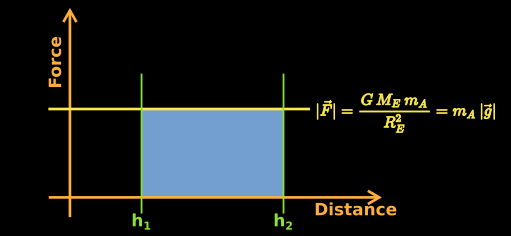
• We know that, the work done is equal to the area enclosed in the force-displacement graph (Details here) The fig.8.39 below shows such a graph:
Fig.8.39
The following points may be noted:
(i) In our present case, the force is a constant. So the graph representing force will be a horizontal line
• This is indicated by the yellow horizontal line
(ii) The distance between this yellow line and the x-axis will be the magnitude of the force
• Also, this distance is the width of the blue rectangle
(iii) The green vertical lines indicate the two heights h1 and h2
    ♦ The first green line is at a distance of h1 from the origin
    ♦ The second green line is at a distance of h2 from the origin
• So the distance between the green lines is (h2-h1)
• Also this distance is the length of the blue rectangle
(iv) So area of the blue rectangle = $\mathbf\small{m_A|\vec{g}|(h_2-h_1)}$
• This area is the work done by gravity in moving the mass from P1 to P2

• If the force is not constant, we will not get a horizontal yellow line. So we will not get a rectangle
• In such cases, the area cannot be calculated easily
• We will now write a detailed analysis on such cases:
1. Let h1 and h2 in the fig.8.38 above, be very large when compared to RE
This can be represented as in fig.8.40(a) below:
Fug.8.40
2. We have: r1 = (RE+h1) and r2 = (RE + h2)
• Since h1 and h2 are very large, we cannot ignore them. That is., we cannot write: r1 = r2 = RE
3. Also, since h1 and h2 are very large when compared to RE, there is no need for splitting the distances as (RE+h1) and (RE+h2)
• We can simply write:
    ♦ P1 is at a distance of r1 from the center of the earth
    ♦ P2 is at a distance of r2 from the center of the earth
4. We want the work done against gravity when mA is moved from P1 to P2
• As usual, we need to use the formula: Work = Force × displacement
5. But the force is not a constant. It changes as we move from P1 to P2
• So what 'value of force' will we use?
6. Let us try the graphical method. Fig.8.41 below shows the force-displacement graph:
Fig.8.41
• The graph (the yellow curve) representing force is not a horizontal line
• It is not even a line. It is a curve
• How do we plot this curve on the graph paper?
The answer can be written in 3 steps:
(i) We have: $\mathbf\small{|\vec{F}|=\frac{G\,M_E\,m_A}{r^2}}$
(ii) This is same as: $\mathbf\small{y=K\left(\frac{1}{x^2}\right)}$
Where:
    ♦ $\mathbf\small{y=|\vec{F}|}$
    ♦ $\mathbf\small{K=G\,M_E\,m_A}$
    ♦ $\mathbf\small{x=r}$
(iii) That means, the equation of the yellow curve is: $\mathbf\small{y=K\left(\frac{1}{x^2}\right)}$
• Putting, various values of x, we will get the corresponding values of y
• Thus the curve can be plotted
(However, we do not need the actual plotting at present. We just need to confirm that, the 'graph of the force' is a curve)
7. Consider the blue region. It is bounded by four items:
(i) The x-axis
(ii) The vertical green line at r1
(iii) The vertical green line at r2
(iv) The yellow curve
8. Using calculus, we can find the area of such complicated shapes
■ For this particular case, calculus gives us this result:
Area of the blue region = $\mathbf\small{G\,M_E\,m_A\left(\frac{1}{r_2}-\frac{1}{r_1}\right)}$
9. But area of the blue region is equal to the work done in moving mA from P1 to P2
So we can write:
Eq.8.14:
Work done in moving mA from P1 to P2 = $\mathbf\small{G\,M_E\,m_A\left(\frac{1}{r_2}-\frac{1}{r_1}\right)}$
10. How do we verify that the right side of Eq.8.14, is indeed a 'work'?
It can be done in 3 steps:
(i) $\mathbf\small{G\,M_E\,m_A\left(\frac{1}{r_2}-\frac{1}{r_1}\right)}$ can be written as: $\mathbf\small{G\,M_E\,m_A\left(\frac{r_1-r_2}{r_1r_2}\right)}$
(ii) Inputting the units, we get: $\mathbf\small{(N\,m^2\,kg^{-2})(kg)(kg)\left(\frac{(m)}{(m)(m)}\right)=N\,m}$
(iii) $\mathbf\small{N\,m}$ corresponds to 'force × displacement', which is 'work done'  
11. Using Eq.8.14, we can calculate the work done for moving the body between any two points P1 and P2
• Let us consider two important points (see fig.8.40.b above):
    ♦ First point P1 is at a distance of r from the center of the earth
    ♦ Second point P2 is at a distance of infinity (∞) from the center of the earth
• Substituting these values in Eq.8.14, we get:
Work done in moving mA from ∞ to P1
= $\mathbf\small{G\,M_E\,m_A\left(\frac{1}{\infty }-\frac{1}{r}\right)}$ = $\mathbf\small{G\,M_E\,m_A\left(0-\frac{1}{r}\right)}$ = $\mathbf\small{\frac{G\,M_E\,m_A}{r}}$
(∵Any quantity divided by  gives zero)
12. ∞ is such a very large distance. At  that distance, there will not be any action of earth's gravity
• Gravitational potential energy comes into effect only if there is an action of gravity
• But at ∞ distance from earth, there is no action of earth's gravity
■ So the gravitational potential energy at ∞ is zero
13. We moved mA from a 'point of zero potential' to P1
• For that, we did a work of $\mathbf\small{\frac{G\,M_E\,m_A}{r}}$ joules
• So the potential energy stored in the body when it is at P1 is $\mathbf\small{\frac{G\,M_E\,m_A}{r}}$ joules
14. This is the case for a body A of mass mA. We can write the general case:
Eq.8.15: $\mathbf\small{U_r=-\frac{G\,M_E\,m}{r}}$
• Where $\mathbf\small{U_r}$ is the gravitational potential energy stored in a body of mass m, when it is at a distance of r from the center of the earth
15. In Eq.8.15, the quantity on the right side is given a negative sign
• The reason can be written in steps:
(i) In the expression, since r is in the denominator, it is clear that when the distance r from the center of the earth increases, the potential energy decreases
(ii) Consider the 3 conditions:
• When r approaches , the potential energy must approach zero
• When r becomes equal to , the potential energy must become equal to zero
• Also, when r increases, the potential energy must increase. This is because, when height increases, the potential energy naturally increases
(iii) So we must satisfy 3 conditions mentioned in (ii)
■ This is possible only if a negative sign is given to the quantity on the right side
(iv) This case is similar to a number line shown in fig.8.42 below:
Fig.8.42
• In this number line, the values of Ur always lies on the left of zero
• As we move from far left towards the right, the absolute value of Ur decreases. But the actual value of Ur is increases
15. We have to note an important point here. It can be written in steps:
(i) The body moves from infinity to P1
(ii) We get the impression that:
• The body falls from infinity to P1, and so, the work done for the motion will be provided by gravity
(iii) But this is not the case
• If the body is allowed to fall freely, some of the energy will be converted to kinetic energy
• We do not want such a 'conversion to kinetic energy'. Because, we want to find the potential energy only
(iv) So, we must ensure that, the body moves (from ∞ to P1) with out acceleration
• For that, we must do work against gravity. This work is stored as potential energy

• So using Eq.8.15, we can calculate the potential energy of a mass m at any point (situated at a distance r) from the center of the earth
• How is all this related to the potential energy mgh that we learned in our previous classes?
• We will see it in the next section


PREVIOUS           CONTENTS          NEXT

Copyright©2020 Higher Secondary Physics. blogspot.in - All Rights Reserved