Showing posts with label gravitational potential conservation of energy. Show all posts

Thursday, January 30, 2020

Chapter 8.15 - When Initial velocity is Greater than or Less than Escape velocity

In the previous sectionwe saw escape velocity
• In this section we will see what happens when the launch velocity is less than or greater than escape velocity

When the launch velocity is greater than the escape velocity
1. Suppose that, an object is launched with a velocity of vi
• Let vi be greater than ve
2. Total energy on the surface of the earth = $\mathbf\small{\frac{1}{2}mv_i^2-\frac{G\,M_E\,m}{R_E}}$
3. Total energy at the final position = $\mathbf\small{\frac{1}{2}mv_f^2+0}$
• Note that, vf will not be zero when vi is greater than ve. We saw the reason in the previous section
4. Equating the two energies, we get: $\mathbf\small{\frac{1}{2}mv_i^2-\frac{G\,M_E\,m}{R_E}=\frac{1}{2}mv_f^2}$
$\mathbf\small{\Rightarrow \frac{1}{2}v_i^2-\frac{G\,M_E}{R_E}=\frac{1}{2}v_f^2}$
5. But we have: $\mathbf\small{v_e=\sqrt{\frac{2GM_E}{R_E}}}$
$\mathbf\small{\Rightarrow v_e^2=\frac{2GM_E}{R_E}}$
$\mathbf\small{\Rightarrow \frac{v_e^2}{2}=\frac{GM_E}{R_E}}$
6. So we can replace the second term in (4). We get:
$\mathbf\small{\frac{1}{2}v_i^2-\frac{v_e^2}{2}=\frac{1}{2}v_f^2}$
$\mathbf\small{\Rightarrow v_i^2-v_e^2=v_f^2}$
Thus we get:
Eq.8.20$\mathbf\small{v_f=\sqrt{v_i^2-v_e^2}}$
7. Thus we can easily calculate vf
■ Once the object is out of the gravitational field, there will not be any force acting on it. So that object will begin to move with a constant velocity of vf

When the launch velocity is less than the escape velocity
1. Suppose that, an object is launched with a velocity of vi
• Let vi be less than ve
2. Total energy on the surface of the earth = $\mathbf\small{\frac{1}{2}mv_i^2-\frac{G\,M_E\,m}{R_E}}$
3. Total energy at the final position:
(i) In this case, the object does not escape from the gravitational field. So it's potential energy does not become zero at the final position
(ii) Let it rise to a maximum height h above the surface of the earth
• Then the potential energy at the final position is $\mathbf\small{-\frac{G\,M_E\,m}{(R_E+h)}}$
(iii) The object continues to rise until it's velocity becomes zero
• h is the height attained at the instant when velocity becomes zero
• So the final kinetic energy is zero
(iv) Thus we can write:
Total energy at the final position = $\mathbf\small{-\frac{G\,M_E\,m}{(R_E+h)}+0}$
4. Equating the energies in (2) and (3), we get:
$\mathbf\small{\frac{1}{2}mv_i^2-\frac{G\,M_E\,m}{R_E}=-\frac{G\,M_E\,m}{(R_E+h)}}$
$\mathbf\small{\Rightarrow \frac{1}{2}v_i^2=\frac{G\,M_E}{R_E}-\frac{G\,M_E}{(R_E+h)}}$
$\mathbf\small{\Rightarrow \frac{1}{2}v_i^2=G\,M_E\left(\frac{1}{R_E}-\frac{1}{(R_E+h)}\right)}$
$\mathbf\small{\Rightarrow \frac{1}{2}v_i^2=G\,M_E\left(\frac{h}{R_E(R_E+h)}\right)}$
$\mathbf\small{\Rightarrow \frac{1}{2}v_i^2=\frac{G\,M_E}{R_E^2}\left(\frac{h}{(1+\frac{h}{R_E})}\right)}$
$\mathbf\small{\Rightarrow v_i^2=2g\left(\frac{h}{(1+\frac{h}{R_E})}\right)}$
$\mathbf\small{\Rightarrow v_i^2=\frac{2\,g\,h}{(1+\frac{h}{R_E})}}$
$\mathbf\small{\Rightarrow v_i^2+v_i^2\frac{h}{R_E}=2\,g\,h}$
$\mathbf\small{\Rightarrow v_i^2\,R_E+v_i^2\,h=2\,g\,h\,R_E}$
$\mathbf\small{\Rightarrow v_i^2\,R_E=(2\,g\,R_E-v_i^2)h}$
$\mathbf\small{\Rightarrow h=\frac{v_i^2\,R_E}{2\,g\,R_E-v_i^2}}$
Thus we get Eq.8.21: $\mathbf\small{h=\frac{v_i^2}{2\,g-\frac{v_i^2}{R_E}}}$
• This is the maximum height that can be achieved when the launch velocity is less than the escape velocity 

Now we will see some solved examples
Solved example 8.38
A body is projected upwards with a velocity of (4 × 11.2) km s-1 from the surface of the earth. What will be the velocity of the body when it escapes from the gravitational field of the earth?
Solution:
• In this problem the launch velocity is greater than escape velocity. So we will use Eq.8.20:
$\mathbf\small{v_f=\sqrt{v_i^2-v_e^2}}$
• Substituting the values, we get: $\mathbf\small{v_f=\sqrt{(4 \times 11.2)^2-11.2^2}=\sqrt{15 \times 11.2^2}=11.2\sqrt{15}}$

Solved example 8.39
A body is projected upwards from the surface of the earth with a velocity equal to one fourth the escape velocity. What is the maximum height that the body will achieve?
Solution:
1. In this problem, the launch velocity is less than escape velocity
• In such cases, we can use Eq.8.21: $\mathbf\small{h=\frac{v_i^2}{2\,g-\frac{v_i^2}{R_E}}}$
2. But it is more convenient to start from the basics. That is., we start by equating the energies:
$\mathbf\small{\frac{1}{2}mv_i^2-\frac{G\,M_E\,m}{R_E}=-\frac{G\,M_E\,m}{(R_E+h)}}$
$\mathbf\small{\Rightarrow \frac{1}{2}v_i^2=\frac{G\,M_E}{R_E}-\frac{G\,M_E}{(R_E+h)}}$
$\mathbf\small{\Rightarrow \frac{1}{2}v_i^2=\frac{G\,M_E}{R_E}-\frac{G\,M_E}{R_E(1+\frac{h}{R_E})}}$
3. But we have: $\mathbf\small{v_e=\sqrt{\frac{2GM_E}{R_E}}}$
$\mathbf\small{\Rightarrow v_e^2=\frac{2GM_E}{R_E}}$
$\mathbf\small{\Rightarrow \frac{v_e^2}{2}=\frac{GM_E}{R_E}}$
4. So the equation in (2) becomes:
$\mathbf\small{\frac{1}{2}v_i^2=\frac{v_e^2}{2}-\frac{v_e^2}{2(1+\frac{h}{R_E})}}$
5. Given that launch velocity is equal to one fourth the escape velocity. So we get:
$\mathbf\small{\frac{1}{32}v_e^2=\frac{v_e^2}{2}-\frac{v_e^2}{2(1+\frac{h}{R_E})}}$
$\mathbf\small{\Rightarrow \frac{1}{32}=\frac{1}{2}-\frac{1}{2(1+\frac{h}{R_E})}}$
$\mathbf\small{\Rightarrow \frac{1}{16}=1-\frac{1}{(1+\frac{h}{R_E})}}$
$\mathbf\small{\Rightarrow \frac{1}{(1+\frac{h}{R_E})}=\frac{15}{16}}$
$\mathbf\small{\Rightarrow (1+\frac{h}{R_E})=\frac{16}{15}}$
$\mathbf\small{\Rightarrow \frac{h}{R_E}=\frac{1}{15}}$
$\mathbf\small{\Rightarrow h=\frac{R_E}{15}}$

Solved example 8.40
A body has to reach a height RE above the surface of the earth. What is the required launch velocity?
Solution:
1. In this problem, a definite target height is given. So the launch velocity is less than escape velocity. Other wise the object will escape from the gravitational field of the earth
• In such cases, we can use Eq.8.21: $\mathbf\small{h=\frac{v_i^2}{2\,g-\frac{v_i^2}{R_E}}}$
2. But it is more convenient to start from the basics. That is., we start by equating the energies:
$\mathbf\small{\frac{1}{2}mv_i^2-\frac{G\,M_E\,m}{R_E}=-\frac{G\,M_E\,m}{(R_E+h)}}$
$\mathbf\small{\Rightarrow \frac{1}{2}v_i^2=\frac{G\,M_E}{R_E}-\frac{G\,M_E}{(R_E+h)}}$
$\mathbf\small{\Rightarrow \frac{1}{2}v_i^2=\frac{G\,M_E}{R_E}-\frac{G\,M_E}{R_E(1+\frac{h}{R_E})}}$
3. But we have: $\mathbf\small{v_e=\sqrt{\frac{2GM_E}{R_E}}}$
$\mathbf\small{\Rightarrow v_e^2=\frac{2GM_E}{R_E}}$
$\mathbf\small{\Rightarrow \frac{v_e^2}{2}=\frac{GM_E}{R_E}}$
4. So the equation in (2) becomes:
$\mathbf\small{\Rightarrow \frac{1}{2}v_i^2=\frac{v_e^2}{2}-\frac{v_e^2}{2(1+\frac{h}{R_E})}}$
5. Given that h = RE. So we get:
$\mathbf\small{\frac{1}{2}v_i^2=\frac{v_e^2}{2}-\frac{v_e^2}{2(1+\frac{R_E}{R_E})}=\frac{v_e^2}{2}-\frac{v_e^2}{4}}$
$\mathbf\small{\Rightarrow \frac{1}{2}v_i^2=\frac{v_e^2}{2}-\frac{v_e^2}{4}=\frac{v_e^2}{4}}$
$\mathbf\small{\Rightarrow v_i=\frac{v_e}{\sqrt{2}}}$
6. But we have: $\mathbf\small{v_e=\sqrt{\frac{2GM_E}{R_E}}}$
So the result in (4) becomes: $\mathbf\small{v_i=\sqrt{\frac{2GM_E}{R_E}} \times\frac{1}{\sqrt{2}}}$
$\mathbf\small{\Rightarrow v_i=\sqrt{\frac{GM_E}{R_E}}}$

Solved example 8.41
A rocket is fired vertically with a speed of 5 km s-1 from the earth’s surface. How far from the earth does the rocket go before returning to the earth ? Mass of the earth = 6.0 × 1024 kg; mean radius of the earth = 6.4 × 106  m; G = 6.67 × 10-11 N mkg-2
Solution:
1. In this problem, the launch velocity is less than escape velocity. The actual values are also given
• In such cases, we can use Eq.8.21: $\mathbf\small{h=\frac{v_i^2}{2\,g-\frac{v_i^2}{R_E}}}$
2. Substituting the values, we get:
$\mathbf\small{h=\frac{5000^2}{2(9.81)-\frac{5000^2}{6400000}}=1590963.33}$ m
3. So distance from the center of the earth = (RE+h) = (6400000 + 1590963.33
7990963.33 m = 8 × 10m

Solved example 8.42
The escape speed of a projectile on the earth’s surface is 11.2 km s-1. A body is projected out with thrice this speed. What is the speed of the body far away from the earth? Ignore the presence of the sun and other planets.
Solution:
• In this problem the launch velocity is greater than escape velocity. So we will use Eq.8.20:
$\mathbf\small{v_f=\sqrt{v_i^2-v_e^2}}$

• Substituting the values, we get: $\mathbf\small{v_f=\sqrt{(3 \times 11.2)^2-11.2^2}=\sqrt{8 \times 11.2^2}=11.2\sqrt{8}=31.7}$ km s-1

• In the next section we will see earth of satellites


PREVIOUS           CONTENTS          NEXT

Copyright©2020 Higher Secondary Physics. blogspot.in - All Rights Reserved

Tuesday, January 28, 2020

Chapter 8.14 - Escape Velocity

In the previous sectionwe saw gravitational potential
• In this section we will see Escape velocity

1. In fig.8.47 below, an object of mass m is being launched from the surface of the earth
Fig.8.47
• Let the initial velocity be vi
• Then the initial kinetic energy Ki = $\mathbf\small{\frac{1}{2}mv_i^2}$
2. We already know the initial potential energy Ui
• That is., the potential energy when the object is at the surface of the earth
• It is given by: Ui $\mathbf\small{-\frac{G\,M_E\,m}{R_E}}$
3. So the initial total energy = Ki + Ui = $\mathbf\small{\frac{1}{2}mv_i^2-\frac{G\,M_E\,m}{R_E}}$
4. Now we want the final values
• We want the object to escape from the gravitational field of the earth
• We know that, as the object rises, the speed goes on decreasing
    ♦ If vi is large the object will rise to a larger height
    ♦ If vi is small, the object will rise only to a smaller height
    ♦ If vi is large enough, the object will rise to such a height that, it is out of the gravitational field
• The height at which the object is out of the gravitational field is our final position. This is shown in fig.8.48 below:
Fig.8.48
5. If vi is more than 'what is sufficient', the object will continue to rise even after escaping from the field
• We do not want this to happen. What we want is to ‘just escape’. We do not want the object to travel further
6. That means, at the instant when the object is out of the field, the velocity must be zero
• This implies that, at the instant when the object is out of the field, the kinetic energy must be zero
7. We can write:
At the final position, vf = 0 ⇒ Kf = 0

8. There is also another implication arising from 'just escape'. We can write it in 6 steps:
(i) If the initial velocity vi is more than ‘what is sufficient’, the object will travel further even after getting out of the field
(ii) We do not want this to happen. We want to ‘just escape’
(iii) So vi must be just equal to ‘what is sufficient’ to ‘just escape’
(iv) We call that velocity: The escape velocity
• It is denoted as ve
(v) The initial velocity vi must be equal to ve. So we can write:
Initial kinetic energy Ki = $\mathbf\small{\frac{1}{2}mv_e^2}$ 
(vi) Thus from (3), we get:
Total initial energy = Ki + Ui = $\mathbf\small{\frac{1}{2}mv_e^2-\frac{G\,M_E\,m}{R_E}}$
9. Next we calculate the potential energy at the final instant
• The ‘instant when the object is out of the field’ implies that, at that instant, there is no influence of the field
• We will have a potential energy only if there is an influence of the field
• So at the final position, there is no potential energy
That is., Uf = 0
10. Thus using the results in (7) and (9), we can write:
Total energy at the final point = (Kf + Uf) = (0 + 0) = 0 
11. The total initial energy must be equal to the total final energy
• Using the results in (8) and (10), we get: $\mathbf\small{\frac{1}{2}mv_e^2-\frac{G\,M_E\,m}{R_E}=0}$
$\mathbf\small{\Rightarrow \frac{1}{2}v_e^2=\frac{G\,M_E}{R_E}}$
• Thus we get: Eq.8.17$\mathbf\small{v_e=\sqrt{\frac{2G\,M_E}{R_E}}}$
12. Multiplying both numerator and denominator by √RE, we get: $\mathbf\small{v_e=\sqrt{\frac{2G\,M_E\,R_E}{R_E^2}}}$
• Thus we get: Eq.8.18$\mathbf\small{v_e=\sqrt{2gR_E}}$
(∵ $\mathbf\small{\frac{2G\,M_E}{R_E^2}=g}$)
13. Inputting the values in Eq.8.18, we get:
$\mathbf\small{v_e=\sqrt{2\times 9.81 \times 6.371 \times 10^6}=11.18 \times 10^3}$ ms-1
14. An important note:
• Throw some thing upwards with initial velocity ve
    ♦ It will escape from the gravitational field of the earth
    ♦ It will escape without any need for 'propulsion by burning fuel'
• Throw some thing upwards with initial velocity less than ve
    ♦ It will escape only if 'propulsion by burning fuel' is supplied   
15. Eq.8.17 shows that, the escape velocity depends only on the mass and radius of the earth
We can write the escape velocity for any planet P:
Eq.8.19$\mathbf\small{v_{e(P)}=\sqrt{\frac{2G\,M_P}{R_P}}}$
Where:
    ♦ $\mathbf\small{v_{e(P)}}$ is the escape velocity of the planet P
    ♦ $\mathbf\small{M_P}$ is the mass of the planet P
    ♦ $\mathbf\small{R_P}$ is the radius of the planet P


Now we will see some solved examples
Solved example 8.33
Calculate the escape velocity from the surface of a planet of mass 14.8 × 1022 kg. Radius of the planet is 3.48 × 106 m
Solution:
• We have Eq.8.19: $\mathbf\small{v_{e(P)}=\sqrt{\frac{2G\,M_P}{R_P}}}$
• Substituting the values, we get:
$\mathbf\small{v_{e(P)}=\sqrt{\frac{2\times 6.67 \times 10^{-11}\times 14.8 \times 10^{22}}{3.48 \times 10^{6}}}}$ = 2381.9 m s-1 = 2.38 km s-1

Solved example 8.34
Mass of Jupiter is 318 times the mass of earth. Radius of Jupiter is 11.2 times the radius of earth. If the escape velocity of earth is 11.2 km s-1, calculate the escape velocity of Jupiter
Solution:
1. For earth, we have: $\mathbf\small{v_{e(E)}=\sqrt{\frac{2G\,M_E}{R_E}}}$  
• For Jupiter, we have: $\mathbf\small{v_{e(J)}=\sqrt{\frac{2G\,M_J}{R_J}}}$
2. Taking ratio of squares, we get:
$\mathbf\small{\frac{v_{e(E)}^2}{v_{e(J)}^2}=\frac{2G\,M_E}{R_E}\times \frac{R_J}{2G\,M_J}=\frac{M_E}{M_J}\times \frac{R_J}{R_E}}$
$\mathbf\small{\Rightarrow \frac{v_{e(E)}^2}{v_{e(J)}^2}=\frac{M_E}{318M_E}\times \frac{11.2R_E}{R_E}=\frac{11.2}{318}}$
$\mathbf\small{\Rightarrow v_{e(J)}^2=\frac{318}{11.2}v_{e(E)}^2}$
$\mathbf\small{\Rightarrow v_{e(J)}^2=\frac{318}{11.2}\times 11.2^2=318 \times 11.2=3561.6}$
$\mathbf\small{\Rightarrow v_{e(J)}=\sqrt{3561.6}=59.7}$ km s-1 

Solved example 8.35
The earth is assumed to be a sphere of radius RE. A platform is arranged at a height of RE from the surface of the earth. The escape velocity of a body from this platform is (k×ve). Where ve is the escape velocity from the surface of the earth. Find the value of k
Solution:
1. The platform is at a distance of 2RE from the center of the earth
• So potential energy of the body when it is on the platform = $\mathbf\small{-\frac{GM_Em}{2R_E}}$
• Where m is the mass of the body
2. The body is launched with an initial velocity of kve from the platform
• So kinetic energy of the body when it is at the platform = $\mathbf\small{\frac{1}{2}m(kv_e)^2=\frac{1}{2}mk^2v_e^2}$
3. So total energy at the platform = $\mathbf\small{-\frac{GM_Em}{2R_E}+\frac{1}{2}mk^2v_e^2}$
4. Total energy when the body has just escaped from earth's gravitational field = 0
5. Applying law of conservation of energy, the results in (3) and (4) must be equal
• So we can write: $\mathbf\small{-\frac{GM_Em}{2R_E}+\frac{1}{2}mk^2v_e^2=0}$
$\mathbf\small{\Rightarrow -\frac{GM_E}{R_E}+k^2v_e^2=0}$
$\mathbf\small{\Rightarrow \frac{GM_E}{R_E}=k^2v_e^2}$
6. Multiplying the numerator and denominator of the left side by 2, we get:
$\mathbf\small{\frac{2GM_E}{2R_E}=k^2v_e^2}$
$\mathbf\small{\Rightarrow \frac{v_e^2}{2}=k^2v_e^2}$
(∵ $\mathbf\small{\frac{2GM_E}{R_E}=v_e^2}$)
$\mathbf\small{\Rightarrow \frac{1}{2}=k^2}$
$\mathbf\small{\Rightarrow k=\frac{1}{\sqrt{2}}}$

Solved example 8.36
We know that, to escape from the gravitational field of the earth, a body must be given a 'minimum initial kinetic energy'. Which of the following is equal to that kinetic energy?
$\mathbf\small{\frac{mgR_E}{2},\;2mgR_E\;,\;mgR_E\;,\;\frac{3mgR_E}{2}}$
Solution:
1. The 'minimum initial kinetic energy' will be equal to $\mathbf\small{\frac{1}{2}mv_e^2}$
2. But ve is equal to $\mathbf\small{\sqrt{2gR_E}}$
3. Substituting in (1), we get:
'Minimum initial kinetic energy' = $\mathbf\small{\frac{1}{2}m(\sqrt{2gR_E})^2}$
= $\mathbf\small{\frac{1}{2}m \times(2gR_E)=mgR_E}$

Solved example 8.37
Two uniform solid spheres of equal radii R, but mass M and 4 M have a center to center separation 6R, as shown in fig. 8.49(a). The two spheres are held fixed. A projectile of mass m is projected from the surface of the sphere of mass M directly towards the center of the second sphere. Obtain an expression for the minimum initial speed vi of the projectile so that it reaches the surface of the second sphere
Fig.8.49
Solution:
1. The mass will exert an attractive force on m
• The magnitude of this attractive force will be $\mathbf\small{\frac{GMm}{r^2}}$
    ♦ Where r is the distance of m from the center of M
    ♦ This is shown in fig.b
• This force acts towards the left
2. The mass 4will also exert an attractive force on m
• The magnitude of this attractive force will be $\mathbf\small{\frac{4GMm}{(6R-r)^2}}$
    ♦ Where r is the distance of m from the center of 4M
• This force acts towards the right
3. The two forces act in opposite directions
The magnitudes of the forces depend on the value of r
4. Let the magnitudes become equal when the m is at N
• Then we have: $\mathbf\small{\frac{GMm}{r^2}=\frac{4GMm}{(6R-r)^2}}$
$\mathbf\small{\Rightarrow \frac{1}{r^2}=\frac{4}{(6R-r)^2}}$
$\mathbf\small{\Rightarrow \frac{1}{r}=\frac{\pm 2}{(6R-r)}}$
• Solving this equation, we get: r = 2R or -6R
• For our present problem, -6R is not acceptable. So we take r = 2R
• We can write: At N, the mass m will experience a zero net force
5. Our aim is to make the mass m to reach N
• We must be able to accomplish this by supplying the 'least possible' external energy
6. The external energy is in the form of kinetic energy
• So we can write:
We must be able to accomplish the task in (5) using the 'least possible' launch velocity
• The launch velocity is the initial velocity vi
• So we must find the least possible vi so that, m will 'just reach' N
• 'Just reach' indicates that, the velocity of m will be zero when it reaches N 
7. So the velocity of m will become zero when it reaches N
• Even though the velocity becomes zero, when it reaches N, the larger mass 4M will pull the mass and so, the m can reach 4M
8. Thus we can write:
The kinetic energy at N is zero
9. We will consider the journey from M to N
• Ki and Ui are the energies of when it is at the surface of M
• Kf and Uf are the energies of when it is at N
10. Next, we will write the values of those energies:
• We have: Ki = $\mathbf\small{\frac{1}{2}mv_i^2}$ 
• Ui will be the sum of two items:
    ♦ Contribution from M
    ♦ Contribution from 4M
• So we get: Ui = $\mathbf\small{-\frac{GMm}{R}+-\frac{4GMm}{5R}}$

• Why do we say that the contribution from 4M is $\mathbf\small{-\frac{4GMm}{5R}}$?
The answer can be written in 4 steps:
(i) The 4M mass creates a 'gravitational potential' around itself in all directions
(We have seen the details in the previous section)
(ii) At a distance of 5R, this potential is equal to $\mathbf\small{-\frac{4GM}{5R}}$
(iii) This is the potential experienced by unit mass
(iv) So a mass m will experience a potential of $\mathbf\small{-\frac{4GMm}{5R}}$

11. So total initial energy = Ki + Ui = $\mathbf\small{\frac{1}{2}mv_i^2-\frac{GMm}{R}-\frac{4GMm}{5R}}$
12. Next we take up the final energies
We know that Uf = 0
13. Uf will be the sum of two items:
    ♦ Contribution from M
    ♦ Contribution from 4M
• So we get: Uf = $\mathbf\small{-\frac{GMm}{2R}+-\frac{4GMm}{4R}}$
14. So total final energy = Kf + Uf = $\mathbf\small{0-\frac{GMm}{2R}-\frac{4GMm}{4R}}$
15. The results in (11) and (14) must be equal. So we can write:
$\mathbf\small{\frac{1}{2}mv_i^2-\frac{GMm}{R}-\frac{4GMm}{5R}=\frac{GMm}{2R}-\frac{4GMm}{4R}}$
• Dividing both sides by m, we get:
$\mathbf\small{\frac{1}{2}v_i^2-\frac{GM}{R}-\frac{4GM}{5R}=\frac{GM}{2R}-\frac{4GM}{4R}}$
• The denominators of the GMterms are 1, 2, 4 and 5. The LCM is 20
• Multiplying both numerators and denominators of those terms by 20, we get:
$\mathbf\small{\frac{1}{2}v_i^2-\frac{20GM}{20R}-\frac{16GM}{20R}=-\frac{10GM}{20R}-\frac{20GM}{20R}}$
$\mathbf\small{\Rightarrow \frac{1}{2}v_i^2=\frac{6GM}{20R}}$
$\mathbf\small{\Rightarrow v_i^2=\frac{3GM}{5R}}$
$\mathbf\small{\Rightarrow v_i=\sqrt{\frac{3GM}{5R}}}$

Now we know the basics about escape velocity. We must always keep the following points in mind:
1. Escape velocity does not depend on the angle of projection. That is., the direction of the velocity vector is not important. 
• This is because, we are considering only the 'kinetic energy due to the velocity'
• But most rockets are launched towards the east direction
• The reason can be explained using fig.8.50 below:
The reason why rockets are launched towards the east. The earth spins from west towards the east.
Fig.8.50
(i) The blue sphere represents the earth. The yellow line is the axis
(ii) The direction of spin is indicated by the curved arrow. This curved arrow points towards the east
• That is., the earth spins towards the east
(iv) So a rocket is launched towards the east. This will give an additional velocity to the rocket
2. From Eq.8.17, we see that, the escape velocity depends upon mass and radius. G is an universal constant
• So value of escape velocity is different for different planets
3. Different molecules in the gaseous atmosphere will be having different velocities. We take an average velocity for calculations. This average velocity is called 'root mean square velocity'.
(i) Consider any planet
(ii) Note down the root mean square velocity of the molecules in the atmosphere of that planet
(iii) If this velocity is less than the escape velocity of that planet, the molecules cannot escape
(iv) In that case, an atmosphere will be present for that planet
• For moon, the escape velocity is very low: 2.3 km s-1
    ♦ So the molecules are able to escape into space, leaving the moon with no atmosphere
• For Jupiter, the escape velocity is very high: 60 km s-1
    ♦ So the molecules are not able to escape. Jupiter has a thick atmosphere
4. We saw that, escape velocity is the initial velocity at the time of launch from the surface of planet
(i) As the object rises, it's velocity decreases
(ii) Finally, when it reaches outer space where there is no influence of gravity, the velocity becomes zero
• The revers steps are also true:
• Drop an object from outer space where there is no influence of gravity
('Drop' indicates that initial velocity is zero)
(i) As the objects descends, the velocity increases
(ii) Finally, when it hits the surface, the velocity will be equal to the escape velocity
5. In calculating the escape velocity, 'air resistance' and 'gravitational effect due to other celestial bodies' are neglected

• In the next section we will see what happens if the speed of launch is greater than or less than the escape velocity


PREVIOUS           CONTENTS          NEXT

Copyright©2020 Higher Secondary Physics. blogspot.in - All Rights Reserved

Thursday, January 23, 2020

Chapter 8.12 - Gravitational Potential Energy

In the previous sectionwe completed a discussion on the basics of gravitational force, gravity and acceleration due to gravity. We saw some solved examples and graphs also. In this section, we will see gravitational potential energy

• We know that, potential energy is that energy which is stored in a body at it’s given position
• If the body moves to a new position, it’s potential energy will change
• The ‘change in potential energy’ is equal to the amount of work done by the ‘force which causes the change in position’ on the body (Details here)
• We saw the definition of conservative forces also
    ♦ If the work done by a force is independent of the path, it is called a conservative force
    ♦ Gravitational force is a conservative force

We will now write a detailed analysis of the potential energy. In this analysis, we will include Newton's laws of gravitation also. We will write it in steps:
1. Consider a point mass mA situated on the exterior of the earth
• Let it be at a distance of r from the center of the earth
2. We know that, the force of attraction experienced by that body will be given by: $\mathbf\small{|\vec{F}_G|=\frac{G\,M_E\,m_A}{r^2}}$
• Since r is in the denominator, it is clear that, the force will decrease with increase in the distance r
    ♦ We will see this same fact if we draw the graph of $\mathbf\small{|\vec{F}_G|}$
    ♦ This graph will be similar to the graph in fig.8.32 that we saw in the previous section 
• A demonstration of the 'decreasing force' can be given in 3 steps:
(i) In fig.8.37(a) below, mA is at a distance of r1 from the center O of the earth
• In fig.b, the same mA is at a distance of r2 from O
Fig.8.37
(ii) In fig.a, the force experienced by mA will be $\mathbf\small{\frac{G\,M_E\,m_A}{r_1^2}}$
• In fig.b, the force experienced by mA will be $\mathbf\small{\frac{G\,M_E\,m_A}{r_2^2}}$  
(iii) We see that, r2 is greater than r1
• Since r1 and r2 are in the denominators, the force in fig.b will be less than the force in fig.a
■ So we can write:
If the same body is taken further away from the earth, it will be experiencing a lesser force of attraction
3. Is there any possibility for the forces in both figs.8.36 (a) and (b) to be the same?
Let us check:
• We know that r can be split up as (RE+h)
• So we get two more figs.: (c) and (d)
    ♦ In fig.c, mA is at a height h1 above the surface of the earth
    ♦ In fig.d, mA is at a height h2 above the surface of the earth
• Note that:
    ♦ Fig.a is same as fig.c. The only difference is that, the distance r1 is split into RE and h1
    ♦ Fig.b is same as fig.d. The only difference is that, the distance r2 is split into RE and h2
4. We know that, the force in fig.d will be less than that in fig.c
• Force acting on mA in fig.c = $\mathbf\small{\frac{G\,M_E\,m_A}{(R_E+h_1)^2}}$
• Force acting on mA in fig.d = $\mathbf\small{\frac{G\,M_E\,m_A}{(R_E+h_2)^2}}$
5. Suppose that, both h1 and h2 are very small when compared to RE. We have seen that, in such cases, those heights can be ignored
We can write:
• Force acting on mA in fig.c = $\mathbf\small{\frac{G\,M_E\,m_A}{R_E^2}}$
• Force acting on mA in fig.d = $\mathbf\small{\frac{G\,M_E\,m_A}{R_E^2}}$
■ Both forces are the same
6. So we can write:
• If the heights attained by a body are very close to the surface of the earth, the same force will be acting on it
• This force is given by: $\mathbf\small{|\vec{F}_G|=\frac{G\,M_E\,m_A}{R_E^2}}$ 
7. In the right side of the above expression, all quantities (except mA) are constants
• So $\mathbf\small{\frac{G\,M_E}{R_E^2}}$ is a constant
• We can calculate the value of this constant as:
$\mathbf\small{\frac{G\,M_E}{R_E^2}=\frac{6.6742 \times 10^{-11}\rm{(m^3\,kg^{-1}\,s^{-2})}\times5.972 \times 10^{24}\rm{(kg)}}{(6.3781 \times 10^{6})^2\rm{(m^2)}}=9.7979\;\rm{m\,s^{-2}}}$
8. So the result in (6) becomes:
• If the heights attained by a body are very close to the surface of the earth, the same force will be acting on it
• This force is given by: $\mathbf\small{|\vec{F}_G|=9.7979\;\rm{(m\,s^{-2}})}\times m_A\,\rm{(kg)}$
9. We see that, a constant force is acting at smaller heights
• If we divide this force by mass, we will get the acceleration experienced by mA 
• We can write: $\mathbf\small{|\vec{a}|=\frac{|\vec{F}_G|}{m_A}=9.7979\;\rm{(m\,s^{-2}})}$
• This $\mathbf\small{|\vec{a}|}$ is the same 'acceleration due to gravity' that we denote as $\mathbf\small{|\vec{g}|}$
• So we can write: $\mathbf\small{|\vec{g}|=9.7979\;\rm{(m\,s^{-2})}}$
■ We see that:
When the mass mA is at smaller heights, it experiences the same acceleration of 9.7979 ms-2 at all those heights
10. The reader must be able to appreciate the following fact:
■ If the heights attained are not very small (when compared to RE), we will not get the same acceleration 9.7979 ms-2 at those heights
• If the reader is not able to appreciate it, he/she must examine the steps (1) to (9) again
• Also recall that, when the heights attained are not very small (when compared to RE), the graph of $\mathbf\small{|\vec{g}_h|}$ is a horizontal line. 
    ♦ A horizontal line indicates a constant value
    ♦ We saw this graph in the fig.8.33 of the previous section  
11. Now we can write every thing in terms of acceleration:
• At smaller heights:
    ♦ A constant acceleration $\mathbf\small{|\vec{g}|}$ is acting on the body
    ♦ Hence, a constant force $\mathbf\small{m_A|\vec{g}|}$ is acting on the body
12. Since the force is constant, we can easily calculate the work done
Work done in lifting the body from h1 to h2 = Force × displacement = $\mathbf\small{m|\vec{g}|(h_2-h_1)}$
13. Now is a good time to write a note about datum
• We can consider any horizontal line as the 'datum line'
• Let us consider the surface of the earth as the datum line. This is shown in the fig.8.38 below:
Fig.8.38
■ We cannot say this:
At the surface of the earth, mA has zero potential energy
• Why we cannot say that?
The answer can be written in 4 steps:
(i) Consider mA to be resting on the surface of the earth
(ii) Let a pit of depth d be made on the surface
(iii) If mA falls freely into that pit, some energy will be released
(iv) So mA has some potential energy even when it is at the datum
14. So what is the 'amount of potential energy that mA possess when it is at the datum'?
• The 'amount of potential energy that mA possess when it is at the datum' does not really matter
• We can write the reason in 5 steps:
(i) Let the 'amount of potential energy that mA possesses when it is at the datum' be W0
(ii) When mA is lifted from the datum to P1, a work of mgh1 will be done on it
• Then we can write:
Amount of potential energy that mA possesses when it is at P1 = mgh1 +W0
(iii) When mA is lifted from the datum to P2, a work of mgh2 will be done on it
• Then we can write:
Amount of potential energy that mA possesses when it is at P2 = mgh2 + W0
(iv) Difference in the potential energies
= (Potential energy at P2 - Potential energy at P1)
= [(mgh2 + W0) - (mgh1 + W0)]
= [mgh2 - mgh1] = mg(h2-h1)
(v) This is the same result obtained in (12)
• W0 gets cancelled
• The difference in potential energies at two points P1 and P2 is equal to the work done in moving the body from P1 to P2 
• So it is the initial and final energies that matter. It is not necessary to know the potential energy at the datum
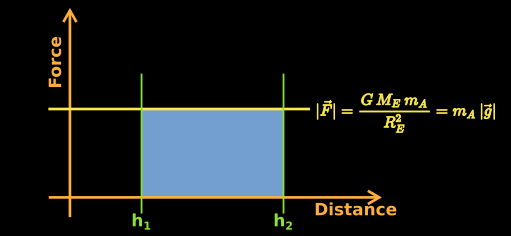
14. Let us make a graphical representation:
• We know that, the work done is equal to the area enclosed in the force-displacement graph (Details here) The fig.8.39 below shows such a graph:
Fig.8.39
The following points may be noted:
(i) In our present case, the force is a constant. So the graph representing force will be a horizontal line
• This is indicated by the yellow horizontal line
(ii) The distance between this yellow line and the x-axis will be the magnitude of the force
• Also, this distance is the width of the blue rectangle
(iii) The green vertical lines indicate the two heights h1 and h2
    ♦ The first green line is at a distance of h1 from the origin
    ♦ The second green line is at a distance of h2 from the origin
• So the distance between the green lines is (h2-h1)
• Also this distance is the length of the blue rectangle
(iv) So area of the blue rectangle = $\mathbf\small{m_A|\vec{g}|(h_2-h_1)}$
• This area is the work done by gravity in moving the mass from P1 to P2

• If the force is not constant, we will not get a horizontal yellow line. So we will not get a rectangle
• In such cases, the area cannot be calculated easily
• We will now write a detailed analysis on such cases:
1. Let h1 and h2 in the fig.8.38 above, be very large when compared to RE
This can be represented as in fig.8.40(a) below:
Fug.8.40
2. We have: r1 = (RE+h1) and r2 = (RE + h2)
• Since h1 and h2 are very large, we cannot ignore them. That is., we cannot write: r1 = r2 = RE
3. Also, since h1 and h2 are very large when compared to RE, there is no need for splitting the distances as (RE+h1) and (RE+h2)
• We can simply write:
    ♦ P1 is at a distance of r1 from the center of the earth
    ♦ P2 is at a distance of r2 from the center of the earth
4. We want the work done against gravity when mA is moved from P1 to P2
• As usual, we need to use the formula: Work = Force × displacement
5. But the force is not a constant. It changes as we move from P1 to P2
• So what 'value of force' will we use?
6. Let us try the graphical method. Fig.8.41 below shows the force-displacement graph:
Fig.8.41
• The graph (the yellow curve) representing force is not a horizontal line
• It is not even a line. It is a curve
• How do we plot this curve on the graph paper?
The answer can be written in 3 steps:
(i) We have: $\mathbf\small{|\vec{F}|=\frac{G\,M_E\,m_A}{r^2}}$
(ii) This is same as: $\mathbf\small{y=K\left(\frac{1}{x^2}\right)}$
Where:
    ♦ $\mathbf\small{y=|\vec{F}|}$
    ♦ $\mathbf\small{K=G\,M_E\,m_A}$
    ♦ $\mathbf\small{x=r}$
(iii) That means, the equation of the yellow curve is: $\mathbf\small{y=K\left(\frac{1}{x^2}\right)}$
• Putting, various values of x, we will get the corresponding values of y
• Thus the curve can be plotted
(However, we do not need the actual plotting at present. We just need to confirm that, the 'graph of the force' is a curve)
7. Consider the blue region. It is bounded by four items:
(i) The x-axis
(ii) The vertical green line at r1
(iii) The vertical green line at r2
(iv) The yellow curve
8. Using calculus, we can find the area of such complicated shapes
■ For this particular case, calculus gives us this result:
Area of the blue region = $\mathbf\small{G\,M_E\,m_A\left(\frac{1}{r_2}-\frac{1}{r_1}\right)}$
9. But area of the blue region is equal to the work done in moving mA from P1 to P2
So we can write:
Eq.8.14:
Work done in moving mA from P1 to P2 = $\mathbf\small{G\,M_E\,m_A\left(\frac{1}{r_2}-\frac{1}{r_1}\right)}$
10. How do we verify that the right side of Eq.8.14, is indeed a 'work'?
It can be done in 3 steps:
(i) $\mathbf\small{G\,M_E\,m_A\left(\frac{1}{r_2}-\frac{1}{r_1}\right)}$ can be written as: $\mathbf\small{G\,M_E\,m_A\left(\frac{r_1-r_2}{r_1r_2}\right)}$
(ii) Inputting the units, we get: $\mathbf\small{(N\,m^2\,kg^{-2})(kg)(kg)\left(\frac{(m)}{(m)(m)}\right)=N\,m}$
(iii) $\mathbf\small{N\,m}$ corresponds to 'force × displacement', which is 'work done'  
11. Using Eq.8.14, we can calculate the work done for moving the body between any two points P1 and P2
• Let us consider two important points (see fig.8.40.b above):
    ♦ First point P1 is at a distance of r from the center of the earth
    ♦ Second point P2 is at a distance of infinity (∞) from the center of the earth
• Substituting these values in Eq.8.14, we get:
Work done in moving mA from ∞ to P1
= $\mathbf\small{G\,M_E\,m_A\left(\frac{1}{\infty }-\frac{1}{r}\right)}$ = $\mathbf\small{G\,M_E\,m_A\left(0-\frac{1}{r}\right)}$ = $\mathbf\small{\frac{G\,M_E\,m_A}{r}}$
(∵Any quantity divided by  gives zero)
12. ∞ is such a very large distance. At  that distance, there will not be any action of earth's gravity
• Gravitational potential energy comes into effect only if there is an action of gravity
• But at ∞ distance from earth, there is no action of earth's gravity
■ So the gravitational potential energy at ∞ is zero
13. We moved mA from a 'point of zero potential' to P1
• For that, we did a work of $\mathbf\small{\frac{G\,M_E\,m_A}{r}}$ joules
• So the potential energy stored in the body when it is at P1 is $\mathbf\small{\frac{G\,M_E\,m_A}{r}}$ joules
14. This is the case for a body A of mass mA. We can write the general case:
Eq.8.15: $\mathbf\small{U_r=-\frac{G\,M_E\,m}{r}}$
• Where $\mathbf\small{U_r}$ is the gravitational potential energy stored in a body of mass m, when it is at a distance of r from the center of the earth
15. In Eq.8.15, the quantity on the right side is given a negative sign
• The reason can be written in steps:
(i) In the expression, since r is in the denominator, it is clear that when the distance r from the center of the earth increases, the potential energy decreases
(ii) Consider the 3 conditions:
• When r approaches , the potential energy must approach zero
• When r becomes equal to , the potential energy must become equal to zero
• Also, when r increases, the potential energy must increase. This is because, when height increases, the potential energy naturally increases
(iii) So we must satisfy 3 conditions mentioned in (ii)
■ This is possible only if a negative sign is given to the quantity on the right side
(iv) This case is similar to a number line shown in fig.8.42 below:
Fig.8.42
• In this number line, the values of Ur always lies on the left of zero
• As we move from far left towards the right, the absolute value of Ur decreases. But the actual value of Ur is increases
15. We have to note an important point here. It can be written in steps:
(i) The body moves from infinity to P1
(ii) We get the impression that:
• The body falls from infinity to P1, and so, the work done for the motion will be provided by gravity
(iii) But this is not the case
• If the body is allowed to fall freely, some of the energy will be converted to kinetic energy
• We do not want such a 'conversion to kinetic energy'. Because, we want to find the potential energy only
(iv) So, we must ensure that, the body moves (from ∞ to P1) with out acceleration
• For that, we must do work against gravity. This work is stored as potential energy

• So using Eq.8.15, we can calculate the potential energy of a mass m at any point (situated at a distance r) from the center of the earth
• How is all this related to the potential energy mgh that we learned in our previous classes?
• We will see it in the next section


PREVIOUS           CONTENTS          NEXT

Copyright©2020 Higher Secondary Physics. blogspot.in - All Rights Reserved