Showing posts with label inclined surface. Show all posts

Friday, September 13, 2019

Chapter 7.39 - More Solved examples on Rolling motion

In the previous sectionwe saw rolling along inclined planes. We saw a solved example also. In this section we will see some solved examples related to rolling motion in general.

Solved example 7.52
A disc rotating about its axis with angular speed $\mathbf\small{|\vec{\omega}_0|}$ is placed lightly (without any translational push) on a perfectly frictionless table. The radius of the disc is R. What are the linear velocities of the points A, B and C on the disc shown in fig. 7.148? Will the disc roll in the direction indicated ?
Fig.7.148
Solution:
1. Since there is no friction, the disc will not roll. It will only spin 
• This is because, there is no external force to cause linear motion 
• We have seen the details here.
2. The angular speed will remain the same $\mathbf\small{|\vec{\omega}_0|}$ because, there is no external torque
• When the disc spins with an angular velocity, every point on it will have a certain linear velocity
3. This linear velocity is given by the equation: $\mathbf\small{|\vec{v}|=|\vec{r}|\times|\vec{\omega}|}$
 Where
• $\mathbf\small{|\vec{v}|}$ is the linear velocity of the particle
• $\mathbf\small{|\vec{r}|}$ is the distance of the particle from the center
• $\mathbf\small{|\vec{\omega}|}$ is the angular velocity with which the object rotates about the axis passing through the center
4. So in our present case, we have:
$\mathbf\small{|\vec{v}_A|=R\times|\vec{\omega}_0|}$ (towards right)
$\mathbf\small{|\vec{v}_B|=R\times|\vec{\omega}_0|}$ (towards left)
$\mathbf\small{|\vec{v}_C|=0.5R\times|\vec{\omega}_0|}$ (towards right)

Solved example 7.53
Explain why friction is necessary to make the disc in fig.7.148 roll in the direction indicated
(a) Give the direction of frictional force at B, and the sense of frictional torque, before perfect rolling
begins
(b) What is the force of friction after perfect rolling begins
Solution:
• If there is no friction, the disc will not roll. It will only spin. 
• This is because, there is no external force to cause linear motion
• We have seen the details here
Part (a):
1. The angular velocity is shown in the clockwise direction
• So the disc will move towards the right
2. Initially there is no perfect rolling. There will be slipping
• The friction will be kinetic in nature
• So the direction of the frictional force will be opposite to the direction of motion. That is., towards the left
3. So before perfect rolling, the frictional torque will be acting in the clockwise direction
Part (b):
1. This is a self propagating disc
• Once the perfect rolling begins, the point of contact with the ground will be at rest
2. An external force of friction will come into play only if the disc tries to accelerate
• Since our disc is not accelerating, the frictional force will be zero

Solved example 7.54
A solid cylinder rolls up an inclined plane of angle of inclination 30°. At the bottom of the inclined plane the centre of mass of the cylinder has a speed of 5 m/s.
(a) How far will the cylinder go up the plane?
(b) How long will it take to return to the bottom?
Solution:
1. At the bottom of the inclined plane, the potential energy is zero
2. Calculation of kinetic energy at bottom:
(i) Rotational kinetic energy 
$\mathbf\small{\frac{1}{2}I\,|\vec{\omega}|^2=\frac{1}{2}\left(\frac{m\,R^2}{2}\right)\left(\frac{|\vec{v}_{CM}|}{R}\right)^2=\frac{m|\vec{v}_{CM}|^2}{4}}$ 
• Note that for a solid cylinder, $\mathbf\small{I=\frac{m\,R^2}{2}}$
(ii) Translational kinetic energy = $\mathbf\small{\frac{1}{2}m\,|\vec{v}_{CM}|^2}$
(iii) So total kinetic energy = $\mathbf\small{\frac{m|\vec{v}_{CM}|^2}{4}+\frac{m|\vec{v}_{CM}|^2}{2}=\frac{3m|\vec{v}_{CM}|^2}{4}}$
3. Let the cylinder roll up to a height of 'h' m
• Then the potential energy at that height = mgh
4. Equating the two energies, we get: $\mathbf\small{mgh=\frac{3m|\vec{v}_{CM}|^2}{4}}$
$\mathbf\small{\Rightarrow h=\frac{3|\vec{v}_{CM}|^2}{4g}}$
• Substituting the values, we get: $\mathbf\small{\Rightarrow h=\frac{3(5)^2}{4(9.8)}=1.913\,\rm{m}}$
5. This 'h = 1.913 m' is the vertical distance. It is shown in fig.7.149 below:
Fig.7.149
• The sloping distance 's' can be calculated as follows:
$\mathbf\small{\sin \theta = \frac{h}{s}}$
$\mathbf\small{\Rightarrow \sin 30 =0.5= \frac{1.913}{s}}$
• Thus we get s = 1.9130.5 = 3.826 m
Part (b):
1. The cylinder rolls back down from the height 1.913 m
• Since there is conservation of energy, we can write:
The linear velocity with which the center of the cylinder reaches the bottom will be the same 5 ms-1
• So, for this rolling back motion, the final velocity v is 5 ms-1
2. We have to find the acceleration with which this rolling back occurs
• For a disc and also for a solid cylinder, we have:
Eq.7.40: $\mathbf\small{|\vec{a}|= \frac{2|\vec{g}|\sin \theta}{3}}$
(We derived this equation in the previous section)
Substituting the values, we get: $\mathbf\small{|\vec{a}|= \frac{2(9.8)\sin 30}{3}=3.27}$ ms-2
3. The initial velocity of this back ward rolling is zero
• We can use the equation: $\mathbf\small{|\vec{v}|=|\vec{u}|+|\vec{a}|t}$
• Substituting the values, we get: 5 = 0 + 3.27t
⇒ t = 1.53 s

Solved example 7.55
In the fig.7.150 below, a spring is compressed through a distance of 25 cm using a sphere and then the sphere is let go.
Fig.7.150
(a) What will be the velocity of the center of mass of the sphere when it is at the bottom of the inclined plane ?
(b) What will be the maximum distance traveled by the sphere along the incline ?
Mass of the sphere = 1.5 kg
Radius of the sphere = 8 cm
Spring constant k = 300 N m-1
Solution:
Part (a):
1. When the spring is compressed, 'spring potential energy' is stored up in it
• When the spring is released, the energy becomes available for the sphere
2. Applying law of conservation of energy, we can write: 
Potential energy stored in the spring
= Rotational kinetic energy at B + translational kinetic energy at B
= Potential energy at C
3. Potential energy stored in the spring
$\mathbf\small{\frac{1}{2}kx^2=\frac{1}{2}(300)(0.25)^2=9.375}$ J
4. Rotational kinetic energy at B
= $\mathbf\small{\frac{1}{2}I\,|\vec{\omega}|^2=\frac{1}{2}\left(\frac{2m\,R^2}{5}\right)\left(\frac{|\vec{v}_{CM}|}{R}\right)^2=\frac{m|\vec{v}_{CM}|^2}{5}}$ 
• Note that for a sphere, $\mathbf\small{I=\frac{2m\,R^2}{5}}$
6. Translational kinetic energy at B
$\mathbf\small{\frac{1}{2}m\,|\vec{v}_{CM}|^2}$
7. So we get:
Rotational kinetic energy at B + translational kinetic energy at B
$\mathbf\small{\frac{m|\vec{v}_{CM}|^2}{5}+\frac{m|\vec{v}_{CM}|^2}{2}=\frac{7m|\vec{v}_{CM}|^2}{10}}$
Substituting the values, we get:
$\mathbf\small{\frac{7m|\vec{v}_{CM}|^2}{10}=\frac{7(1.5)|\vec{v}_{CM}|^2}{10}=1.05|\vec{v}_{CM}|^2}$
8. Equating this to the result in (3), we get: $\mathbf\small{1.05|\vec{v}_{CM}|^2=9.375}$
$\mathbf\small{\Rightarrow|\vec{v}_{CM}|=2.99}$ ms-1
Part (b):
1. From (2) in part (a), we have:
Potential energy stored in the spring = Potential energy at C
2. From (3) in part (a), we have:
Potential energy stored in the spring = 9.375 J
3. Potential energy at C
= mgh = (1.5)(9.8)(h) = 14.7 h J
4. Equating the results in (2) and (3), we get: 9.375 = 14.7 h
h = 0.638 m
5. So s = 0.638sin 30 = 1.276 m

Solved example 7.56
A string is wound around a solid cylinder. The free end of the string is attached firmly to the ceiling as shown in fig.7.151 below. The cylinder is let go from a height of h from the ground. What will be the velocity of the CM of the cylinder when it just reaches the ground ?
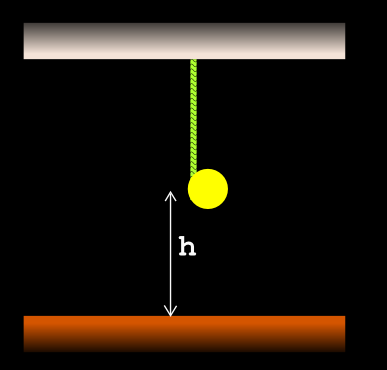
Fig.7.151
Solution:
1. Applying law of conservation of energy, we can write: 
Potential energy of the cylinder at height h
= Rotational kinetic energy of cylinder at ground + translational kinetic energy of cylinder at ground
2. Potential energy of the cylinder when it is at a height h = mgh
3. Rotational kinetic energy at ground
= $\mathbf\small{\frac{1}{2}I\,|\vec{\omega}|^2=\frac{1}{2}\left(\frac{m\,R^2}{2}\right)\left(\frac{|\vec{v}_{CM}|}{R}\right)^2=\frac{m|\vec{v}_{CM}|^2}{4}}$ 
• Note that for a solid cylinder, $\mathbf\small{I=\frac{m\,R^2}{2}}$
4. Translational kinetic energy at B
$\mathbf\small{\frac{1}{2}m\,|\vec{v}_{CM}|^2}$
5. So we get:
Rotational kinetic energy at B + translational kinetic energy at B
$\mathbf\small{\frac{m|\vec{v}_{CM}|^2}{4}+\frac{m|\vec{v}_{CM}|^2}{2}=\frac{3m|\vec{v}_{CM}|^2}{4}}$
6. Equating the energies, we get: $\mathbf\small{mgh=\frac{3m|\vec{v}_{CM}|^2}{4}}$
$\mathbf\small{\Rightarrow|\vec{v}_{CM}|=\sqrt{\frac{4gh}{3}}}$

We have completed a discussion on rotational motion. In the next chapter, we will see gravitation


PREVIOUS           CONTENTS          NEXT

Copyright©2019 Higher Secondary Physics. blogspot.in - All Rights Reserved

Thursday, September 12, 2019

Chapter 7.38 - Rolling along in Inclined planes

In the previous sectionwe saw the maximum force that can be applied on a wheel which is not able to self propagate. In this section we will see the case of objects rolling along inclined planes

1. Consider the disc shown in fig.7.147 (a) below
Fig.7.147(a)
• It has a mass m and radius R
• It is rolling down an inclined plane. The angle of inclination is θ
■ We want the disc to have 'pure rolling'. That is., there must not be any slip
2. This disc is not able to self propagate because there is no engine attached
• But it's self weight will cause it to move
• This will be clear when we draw all the force vectors acting on the wheel. They are shown in fig.b
We have:
(i) The weight $\mathbf\small{m|\vec{g}|}$ acting downwards from the center C
    ♦ The component $\mathbf\small{m|\vec{g}|\cos \theta}$ acts parallel to the inclined plane
    ♦ The component $\mathbf\small{m|\vec{g}|\sin \theta}$ acts perpendicular to the inclined plane
(ii) The normal reaction $\mathbf\small{|\vec{N}|}$ acting perpendicular to the plane
    ♦ This acts at the point of contact
    ♦ The magnitude is equal to $\mathbf\small{m|\vec{g}|\cos \theta}$  
(This force is not shown in the fig)
(iii) The frictional force  $\mathbf\small{|\vec{f_s}|=\mu_s|\vec{N}|=\mu_sm|\vec{g}|\cos \theta}$
    ♦ This force acts parallel to the inclined plane 
• Note that, we use the 𝝁s instead of 𝝁k because, we want pure rolling
• Also recall that, when there is no self propagation, the frictional force will be opposite to the direction of motion
3. Our aim is to find the maximum force acting on the disc so that no slipping occurs
• We will separate the calculations into two sets:
Set 1 comprises of the calculations related to rotation
Set 2 comprises of the calculations related to translation
4. Set 1:
(i) If there is a rolling motion, there has to be a torque
• This torque is provided by the frictional force $\mathbf\small{|\vec{f_s}|}$
• Because, all other forces are acting through the center of the wheel
• So we have: $\mathbf\small{|\vec{\tau}|=|\vec{f_s}|R=\mu_sm|\vec{g}|R \cos \theta}$
• $\mathbf\small{\mu_sm|\vec{g}|R \cos \theta}$ is the maximum frictional force possible
• So we can write: $\mathbf\small{|\vec{\tau}_{max}|=\mu_sm|\vec{g}|R \cos \theta}$
(ii) But $\mathbf\small{|\vec{\tau}|=I\,|\vec{\alpha}|}$
• Where:
    ♦ $\mathbf\small{I}$ is the moment of inertia of the wheel
    ♦ $\mathbf\small{|\vec{\alpha}|}$ is the angular acceleration of the wheel
(iii) For pure rolling, we have Eq.7.36 that we derived in the previous section: $\mathbf\small{|\vec{a}|=R\,|\vec{\alpha}|}$
• Rearranging this, we get: $\mathbf\small{|\vec{\alpha}|=\frac{|\vec{a}|}{R}}$
(iv) For our present case, we must consider the maximum allowable angular acceleration
• So we must denote it as $\mathbf\small{|\vec{\alpha}_{max}|}$
• So we have: $\mathbf\small{|\vec{\alpha}_{max}|=\frac{|\vec{a}_{max}|}{R}}$
(v) Thus from (ii), we get: $\mathbf\small{|\vec{\tau}_{max}|=I\,\frac{|\vec{a}_{max}|}{R}}$
• We know the I of the disc: $\mathbf\small{I=\frac{mR^2}{2}}$
• So we get: $\mathbf\small{|\vec{\tau}_{max}|=\left(\frac{mR^2}{2}\right)\,\frac{|\vec{a}_{max}|}{R}=\frac{mR|\vec{a}_{max}|}{2}}$  
(vi) So the result in (i) becomes: $\mathbf\small{\frac{mR|\vec{a}_{max}|}{2}=\mu_sm|\vec{g}|R \cos \theta}$
• From this we get: $\mathbf\small{|\vec{a}_{max}|= 2\mu_s|\vec{g}|\cos \theta}$
5. Set 2:
 We have: Net force = mass × acceleration
• In our present case:
Net force = $\mathbf\small{m|\vec{g}|\sin \theta-|\vec{f_s}|}$
= $\mathbf\small{m|\vec{g}|\sin \theta-\mu_s\,m|\vec{g}|\cos \theta}$
$\mathbf\small{m|\vec{a}_{max}|}$
6. The two sets are complete
• We take the result from Set 1 (vi)
• And apply it in the result from Set 2
• We get:
Net force 
$\mathbf\small{m|\vec{g}|\sin \theta-\mu_s\,m|\vec{g}|\cos \theta}$
$\mathbf\small{m\times 2\mu_s|\vec{g}|\cos \theta}$
$\mathbf\small{\Rightarrow m|\vec{g}|\sin \theta=3\mu_s\,m|\vec{g}|\cos \theta}$   
7. The quantity $\mathbf\small{|\vec{F}_{max}|}$ is the force that causes the disc to roll
• It is denoted as $\mathbf\small{|\vec{F}_{max}|}$  
8. Thus we get:
Eq.7.38: 
For a disc rolling down an inclined plane:
$\mathbf\small{|\vec{F}_{max}|}$
= $\mathbf\small{m|\vec{g}|\sin \theta}$
= $\mathbf\small{m\times2\mu_s|\vec{g}|\cos \theta+m\times\mu_s|\vec{g}|\cos \theta=3\mu_sm|\vec{g}|\cos \theta}$
= $\mathbf\small{3\mu_sm|\vec{g}|\cos \theta}$
• Note that, this equation is valid only for a disc and a solid cylinder. For other types of objects, suitable equations must be derived using the appropriate values of I 
9. We see that $\mathbf\small{m|\vec{g}|\sin \theta}$ is the force that causes the disc to move
• This $\mathbf\small{m|\vec{g}|\sin \theta}$ must not exceed a 'certain value'
• This 'certain value' is: $\mathbf\small{3\mu_sm|\vec{g}|\cos \theta}$
10. So we can write:
$\mathbf\small{m|\vec{g}|\sin \theta}$ should always be less than or equal to $\mathbf\small{3\mu_sm|\vec{g}|\cos \theta}$
• That is: $\mathbf\small{m|\vec{g}|\sin \theta\;\;\leq \;\;3\mu_sm|\vec{g}|\cos \theta}$  
• Where
    ♦ $\mathbf\small{m|\vec{g}|\sin \theta}$ is the actual force acting
    ♦ $\mathbf\small{3\mu_sm|\vec{g}|\cos \theta}$ is the maximum allowable force
11. If the left side ever becomes greater than the right side, we will have to make adjustments
• We cannot change mass because, it occurs on both sides
• We see that 𝝁s occurs on the right side only
• So, if the left side increases beyond the limit, we can increase the right side by increasing 𝝁s.
An example:
• m = 5 kg, θ = 35o and 𝝁s = 0.2
Then:
(i) Actual force acting = $\mathbf\small{m|\vec{g}|\sin \theta}$ = 28.1 N
(ii) Maximum allowable force = $\mathbf\small{3\mu_sm|\vec{g}|\cos \theta}$ = 24.1 N
(iii) We have to increase (ii). For that, we will increase the 𝝁s. This can be achieved by increasing the roughness of surface
(iv) But what must be the new value of 𝝁s ?
• To find that, we consider the inequality:
$\mathbf\small{m|\vec{g}|\sin \theta\;\;\leq \;\;3\mu_sm|\vec{g}|\cos \theta}$
• If we multiply or divide both sides of an inequality by a same quantity, the 'inequality' will not change
(v) Here, we will divide both sides by $\mathbf\small{m|\vec{g}|\cos \theta}$. We get:
$\mathbf\small{\tan \theta\;\;\leq \;\;3\mu_s}$
• Dividing both sides by 3, we get:
$\mathbf\small{\frac{\tan \theta}{3}\;\;\leq \;\;\mu_s}$
(vi) That means 𝝁s must be just greater than $\mathbf\small{\frac{\tan \theta}{3}}$
• If this condition is satisfied, the allowable force will be just sufficient
12. So for our present case, 𝝁s must be just greater than (tan 353) = 0.233
• Let us provide a 𝝁s of 0.25   
13. Let us check with the new data:
• m = 5 kg, θ = 35o and 𝝁s = 0.25
Then:
(i) Actual force acting = $\mathbf\small{m|\vec{g}|\sin \theta}$ = 28.1 N
(ii) Maximum allowable force = $\mathbf\small{3\mu_sm|\vec{g}|\cos \theta}$ = 30.1 N
Note: In actual situations, various safety factors must be multiplied to the newly obtained 𝝁sOnly then it will be considered safe. We will learn about them in higher classes 
14. If the 𝝁s cannot be changed, then the only option is to change θ 
(i) To find the new value of θ, we consider the inequality:
$\mathbf\small{m|\vec{g}|\sin \theta\;\;\leq \;\;3\mu_sm|\vec{g}|\cos \theta}$
• If we multiply or divide both sides of an inequality by a same quantity, the 'inequality' will not change
(ii) Here, we will divide both sides by $\mathbf\small{m|\vec{g}|\cos \theta}$. We get:
$\mathbf\small{\tan \theta\;\;\leq \;\;3\mu_s}$
Thus we get:
7.39: $\mathbf\small{\theta\;\;\leq \;\;\tan^{-1}(3\mu_s)}$
• Note that, this relation is valid only for a disc and a solid cylinder. For other types of objects, suitable relations must be derived using the appropriate values of I
(iii) That means, θ should be brought down so that, it is just less than $\mathbf\small{tan^{-1}(3\mu_s)}$
(iv) If this condition is satisfied, the allowable force will be just sufficient
15. So for our present case, θ must be just less than [tan-1 (3 × 0.2)] = 30.96o
• Let us provide a θ of 30
16. Let us check with the new data:
• m = 5 kg, θ = 30o and 𝝁s = 0.2
Then:
(i) Actual force acting = $\mathbf\small{m|\vec{g}|\sin \theta}$ = 24.5 N
(ii) Maximum allowable force = $\mathbf\small{3\mu_sm|\vec{g}|\cos \theta}$ = 25.5 N
Note: In actual situations, various safety factors must be multiplied to the newly obtained θ. Only then it will be considered safe. We will learn about them in higher classes

Let us write a summary of the above discussion. The summary can be written in 3 steps:
1. We have a disc rolling down an inclined plane
• From the given data, we are  able to find the following items:
(i) The maximum force that will be causing the motion:
$\mathbf\small{|\vec{F}_{max}|}$ = $\mathbf\small{m|\vec{g}|\sin \theta}$
(ii) The maximum allowable force:
$\mathbf\small{3\mu_sm|\vec{g}|\cos \theta}$
• Using the above two items, we can determine whether the disc will slip or not 
2. The condition at which the two items become equal is the 'limiting condition'
• At that condition, 'maximum allowable net force' will be acting on the disc
• This is given by: Net force = $\mathbf\small{m|\vec{g}|\sin \theta-|\vec{f_s}|}$
= $\mathbf\small{m|\vec{g}|\sin \theta-\mu_s\,m|\vec{g}|\cos \theta}$ 
3. That means, at that condition, the disc will be experiencing $\mathbf\small{|\vec{a}_{max}|}$ the 'maximum allowable linear acceleration' 
• And we know the method to find that maximum allowable linear acceleration:
$\mathbf\small{|\vec{a}_{max}|= 2\mu_s|\vec{g}|\cos \theta}$

1. But what if the disc is rolling well within the limit?
This will occur under the following conditions:
• 𝝁s is greater than the limiting value
or
• θ is less than the limiting value   
2. In such a situation, the acceleration $\mathbf\small{|\vec{a}|}$  experienced by the disc will be less than $\mathbf\small{|\vec{a}_{max}|}$
3. In such a situation, the force ($\mathbf\small{m|\vec{g}|\sin \theta}$) which causes motion of the disc will be well within the safe limit
4. We want to know the $\mathbf\small{|\vec{a}|}$ in such a situation
5. This is a special situation
The reason for the situation becoming 'special' can be written in 6 steps:
(i) We usually calculate the static frictional force using 𝝁s 
(ii) But such a calculation gives the 'maximum static frictional force which is possible'
(iii) When the disc is rolling well with in the safe limit, this maximum static frictional force will not be acting on it
(iv) Because, we know that, static friction is a self adjusting force
    ♦ It increases when the applied force increases
    ♦ It decreases when the applied force decreases
■ Here we experience the difference between rolling motion and sliding motion
• The sliding motion begins only when the full available frictional force is exceeded
• The rolling motion does not wait for 'the full available frictional force to be exceeded'
(v) In our present case, the applied force $\mathbf\small{m|\vec{g}|\sin \theta}$ is so less that, the full static frictional force is not mobilized
• So we do not know exactly how much static friction is acting  
• So we cannot use 𝝁s
6. However, we can derive a formula, which does not involve the coefficient
We will separate the calculations into two sets:
• Set 1 comprises of the calculations related to rotation
• Set 2 comprises of the calculations related to translation
7. Set 1:
(i) $\mathbf\small{|\vec{\tau}|=I|\vec{\alpha}|=\frac{mR^2}{2}|\vec{\alpha}|=\frac{mR^2}{2}\times\frac{|\vec{a}|}{R}=\frac{mR|\vec{a}|}{2}}$
(ii) But $\mathbf\small{|\vec{\tau}|=\mu m|\vec{g}|\cos \theta \times R}$
(iii) Equating the results, we get: $\mathbf\small{|\vec{\tau}|=\mu\,m|\vec{g}|\cos \theta \times R=\frac{mR|\vec{a}|}{2}}$
$\mathbf\small{\Rightarrow \mu|\vec{g}|\cos \theta=\frac{|\vec{a}|}{2}}$
8. Set 2:
Net force = $\mathbf\small{m|\vec{g}|\sin \theta-\mu\;m|\vec{g}|\cos \theta=m|\vec{a}|}$
9. The two sets are complete
• Now we take the result from Set 1 (iii) 
• And apply it in the result from Set 2
We get:
Net force = $\mathbf\small{m|\vec{g}|\sin \theta-m\times\frac{|\vec{a}|}{2}=m|\vec{a}|}$
$\mathbf\small{\Rightarrow m|\vec{g}|\sin \theta=\frac{3m|\vec{a}|}{2}}$
$\mathbf\small{\Rightarrow |\vec{a}|=\frac{2|\vec{g}|\sin \theta}{3}}$
10. We can write:
When a disc is rolling down an incline with out slipping, the linear acceleration is given by:
Eq.7.40: $\mathbf\small{|\vec{a}|=\frac{2|\vec{g}|\sin \theta}{3}}$
• Note that, this equation is valid only for a disc and a solid cylinder. For other types of objects, suitable equations must be derived using the appropriate values of I

Solved example 7.51
A cylinder of mass 10 kg and radius 15 cm is rolling perfectly on a plane of inclination 30o. The coefficient of static friction  𝝁s = 0.25.
(a) How much is the force of friction acting on the cylinder ?
(b) What is the work done against friction during rolling ?
(c) If the inclination θ of the plane is increased, at what value of θ does the cylinder begin to skid,
and not roll perfectly ?
Solution:
• Both solid cylinder and disc have the same I. So the equations that we derived above are applicable for this problem
• First we need to know whether the maximum frictional force is mobilized or not
• For that we do the following 4 steps:
1. We will use the relation in Eq.7.38: For a disc rolling down an inclined plane:
$\mathbf\small{|\vec{F}_{max}|}$ = $\mathbf\small{m|\vec{g}|\sin \theta}$
• This maximum force must be less than or equal to $\mathbf\small{3\mu_sm|\vec{g}|\cos \theta}$ 
2. Substituting the values we get:
$\mathbf\small{m|\vec{g}|\sin \theta=49\,\rm{N}}$
3. Similarly, we get: $\mathbf\small{3\mu_sm|\vec{g}|\cos \theta=63.65\,\rm{N}}$
4. Result in (2) is less than the result in (3)
• So it is safe. The cylinder will not slip. Also there is no need to mobilize the maximum available frictional force
• Now we can find the answers to the given questions
Part (a):
1. To find the actual acceleration, we use
Eq.7.40: $\mathbf\small{|\vec{a}|=\frac{2|\vec{g}|\sin \theta}{3}}$
• Substituting the values, we get: $\mathbf\small{|\vec{a}|=3.27\,\rm{m\,s^{-2}}}$
2. We have:
Net force = Force acting downwards along the slope - Frictional force
⇒ Net force = [$\mathbf\small{m|\vec{g}|\sin \theta}$ - Frictional force]
⇒ Net force = [49 - Frictional force]
3. But net force = Mass × acceleration = (10 × 3.27) = 32.7 N
4. So the result in (2) becomes:
32.7 = [49 - Frictional force]
⇒ Frictional force = 49 - 32.7 = 16.3 N
Part (b):
1. We have: Work done = Force × Displacement   
2. The frictional force acts on every particle on the periphery of the cylinder
3.  Consider the instant at which a particle experiences the frictional force
• At that instant, the displacement of that particle is zero
• At the next instant, the frictional force no longer acts on that particle
    ♦ Because, the succeeding particle takes up it's position
4. So displacement is always zero
5. So no work is done against the frictional force
Part (c):
• We will use the relation in 7.39: $\mathbf\small{\theta\;\;\leq \;\;\tan^{-1}(3\mu_s)}$
• Substituting the values we get: θ ≤ tan-1 (3 × 0.25)
⇒ θ ≤ tan-1 (0.75)
⇒ θ  36.87
• So if θ is greater than 36.87o, the cylinder will begin to skid

We have completed a discussion on rolling motion. In the next section, we will see a few more solved examples


PREVIOUS           CONTENTS          NEXT

Copyright©2019 Higher Secondary Physics. blogspot.in - All Rights Reserved

Saturday, August 31, 2019

Chapter 7.34 - Rolling without Slipping

In the previous sectionwe saw conservation of angular momentum. In this section, we will see rolling motion

1. Consider a disc rolling on a horizontal surface (Fig.7.137 (a) below)
 Radius of the disc is R
Rolling motion of a disc
Fig.7.137
■ Since it is rolling, it will have two types of motion:
(i) Translational motion
(ii) Rotational motion
2. Let us write all the available information about the rotational motion:
(i) The disc is a symmetric body
• So the rotation will be about an axis passing through the center C
• Also, this axis will be perpendicular to the plane of the disc (that is., plane of the computer screen)
(ii) The angular velocity of rotation is $\mathbf\small{\vec{\omega}}$
• All particles (except the particle at C) in the disc will be rotating with this same angular velocity
(iii) The particle at C will not have any rotational motion
3. Next we write all the available information about the translational motion:
(i) The particle at C does not have any rotational motion. But it does have translational motion
(ii) Since C is the center of mass (CM) of the disc, we will denote the translational velocity of C as $\mathbf\small{\vec{v}_{CM}}$ 
• This $\mathbf\small{\vec{v}_{CM}}$ is parallel to the surface on which the disc rolls
(iii) Since the disc is rigid, all particles will have the same translational velocity
4. Our next aim is to find this $\mathbf\small{\vec{v}_{CM}}$
• Consider fig.b, An arc AP is marked in magenta color on the periphery of the disc  
• This arc subtends an angle of θ at the center C
5. The fig.b shows the instant at which A is in contact with the ground
6. The disc rolls towards the right
• Point A will lose contact with the surface
• As the rolling proceeds, new points on the arc will come into contact with the surface 
7. Consider the instant at which P comes into contact with the surface   
8. What is the linear distance covered by the disc between the following two instances:
    ♦ Instance mentioned in (5)
    ♦ Instance mentioned in (7)
Answer: Obviously, the linear distance will be equal to the length of the arc AP
(Note that, this will be true only if there is no slipping/skidding between the disc and the surface. For our present discussion, we assume that there is no such slipping/skidding)
9. We know how to find this length of arc
• We have: angle = Arc lengthradius   (Where angle is in radians)
• So Arc length AP = Linear distance traveled by the disc =  Rθ.
10. Let 't' be the time duration between the two instances
• Then we can write two more information:
(i) The disc travels a linear distance of Rθ during a time 't' s
(ii) The disc turns through an angle θ during a time 't' s
11. Let us write the above equation again:
• Linear distance traveled by the disc =  Rθ.
• Dividing both sides by 't', we get:
$\mathbf\small{\frac{\text{Linear distance traveled by the disc}}{t}=\frac{R\theta}{t}}$
• But $\mathbf\small{\frac{\text{Linear distance traveled by the disc}}{t}}$ is the linear velocity with which the disc travels during the time interval 't'
    ♦ 'Linear velocity of the disc' is the 'velocity of the center of mass'
    ♦ We denoted it as $\mathbf\small{\vec{v}_{CM}}$  
• Also, $\mathbf\small{\frac{\theta}{t}}$ is the angular velocity with which the disc turns during the time interval 't'
    ♦ We denoted the angular velocity as $\mathbf\small{\vec{\omega}}$
■ Thus we get: 
Eq.7.32: $\mathbf\small{|\vec{v}_{CM}|=R|\vec{\omega}|}$
• Since it is a rigid body, every particle in the disc will have a translational velocity of $\mathbf\small{|\vec{v}_{CM}|}$ towards the right
12. This equation is similar to: $\mathbf\small{\vec{v}=R\,\vec{\omega}}$ 
• $\mathbf\small{\vec{v}}$ is the 'tangential velocity' of a particle at the periphery of a rotating body 
• But $\mathbf\small{\vec{v}_{CM}}$ is the linear velocity with which the disc rolls
• We must clearly note the difference between the two
 Eq.7.32 gives the condition for 'no slipping'
• Because if there is slipping, arc length will not be equal to the linear distance. The equation will not be valid any more
13. Let us see another interesting information:
• Fig.7.138(a) below shows 3 points in the disc:
(i) The bottom most point A
(ii) The center of mass C
(iii) The top most point B
Fig.7.138
• A and B pass through a vertical through C
14. First we will consider point B:
• The disc has an angular velocity of $\mathbf\small{|\vec{\omega}|}$ 
• Then the point B will be moving towards the right with a tangential velocity of $\mathbf\small{R\,|\vec{\omega}|}$
• Note that, this velocity will be parallel to the ground. That is., parallel to $\mathbf\small{|\vec{v}_{CM}|}$
• Also, this velocity is towards the right
15. We have seen that, due to translation, already every point in the disc has a velocity of $\mathbf\small{R|\vec{\omega}|}$ towards the right. For point B, this is shown in fig.b
• So for point B, the two velocities will add up
• Thus we can write:
Point B moves towards the right with a net velocity of $\mathbf\small{2R|\vec{\omega}|}$. This is shown in fig.c
16. But at the next instant, a succeeding particle takes over the position of B. This new particle will experience the same effect
■ So in general, we can write:
At any instant, the top most point of the disc will be travelling towards the right with a velocity of $\mathbf\small{2R|\vec{\omega}|}$
17. Next we will consider point C
• The point C is in the axis of rotation. So it will receive no contribution (towards velocity) from the rotation. Because, every point on the axis will be having zero rotation
• But C has translational velocity $\mathbf\small{|\vec{v}_{CM}|}$. It is the only velocity it has. This is shown in fig.b
■ Thus we can write:
Point C moves towards the right with a net velocity of $\mathbf\small{R|\vec{\omega}|}$. This is shown in fig.c        
18. Finally we consider point A
• The disc has an angular velocity of $\mathbf\small{|\vec{\omega}|}$ 
• Then the point A will be moving towards the left with a tangential velocity of $\mathbf\small{R\,|\vec{\omega}|}$. This is shown in fig.a
• Note that, this velocity will be parallel to the ground. That is., parallel to $\mathbf\small{|\vec{v}_{CM}|}$
• Also, this velocity is towards the left
19. We have seen that, due to translation, already every point in the disc has a velocity of $\mathbf\small{R|\vec{\omega}|}$ towards the right. For point A, this is shown in fig.b
• So for point A, the two velocities will cancel each other
• Thus we can write:
Point A has zero net velocity. This is shown in fig.c
20. But at the next instant, the succeeding particle takes over the position of A, This new particle will experience the same effect
■ So in general, we can write:
At any instant, the bottom most point of the disc will be having zero net velocity
• That means, the point of contact (with the ground) of a rolling wheel/disc will be at rest


Kinetic energy of a rolling body


We will write this in steps:
1. A rolling body has both rotational and translational motion
2. We know that kinetic energy due to rotation is $\mathbf\small{\frac{1}{2}I\,|\vec{\omega}|^2}$
Where:
• I = Moment of inertia of the body about the axis of rotation
• $\mathbf\small{|\vec{\omega}|}$ = Magnitude of the angular velocity
3. Also we know that kinetic energy due to translation is $\mathbf\small{\frac{1}{2}m\,|\vec{v}_{CM}|^2}$
Where:
• m = mass of the body
• $\mathbf\small{|\vec{v}_{CM}|}$ = magnitude of the linear velocity
4. So the total kinetic energy possessed by a rolling body is given by:
Eq.7.33: $\mathbf\small{K=\frac{1}{2}I\,|\vec{\omega}|^2+\frac{1}{2}m\,|\vec{v}_{CM}|^2}$

Solved example 7.44
A disc of mass 5 kg and radius 50 cm rolls on the ground with out slipping. It's linear velocity is 10 ms-1. What is the kinetic energy possessed by the disc?
Solution:
1. Kinetic energy due to rotation = $\mathbf\small{\frac{1}{2}I\,|\vec{\omega}|^2}$
(i) Moment of inertia (I) should be selected carefully
• A disc can have a moment of inertia about an axis which can be an extension of one of it's diameters
• It can also have a moment of inertia about an axis perpendicular to the disc. Obviously, a disc can roll only if the axis is perpendicular to the disc. So we must take the I corresponding to this axis
Thus we have: $\mathbf\small{I=\frac{1}{2}m\,R^2}$
(ii) Next we calculate $\mathbf\small{|\vec{\omega}|}$
• Given that the disc rolls without slipping. So the condition $\mathbf\small{|\vec{v}_{CM}|=R|\vec{\omega}|}$ will be satisfied
• So we get: $\mathbf\small{|\vec{\omega}|=\frac{|\vec{v}_{CM}|}{R}}$
(iii) Substituting these expressions in (1), we get:
Kinetic energy due to rotation = $\mathbf\small{\frac{1}{2}\left(\frac{1}{2}m\,R^2\right)\left(\frac{|\vec{v}_{CM}|}{R}\right)^2=\frac{m|\vec{v}_{CM}|^2}{4}}$
2. Kinetic energy due to translation = $\mathbf\small{\frac{1}{2}m\,|\vec{v}_{CM}|^2}$
3. So total kinetic energy = $\mathbf\small{\frac{m|\vec{v}_{CM}|^2}{4}+\frac{m|\vec{v}_{CM}|^2}{2}=\frac{3m|\vec{v}_{CM}|^2}{4}}$
• Substituting the values, we get:
Total kinetic energy = $\mathbf\small{\frac{3(5\,\rm{kg})(10\,\rm{m\,s^{-1}})^2}{4}=375\;\rm{J}}$
• Recall that dimensions of energy is: ML2T-2.

Solved example 7.45
Three bodies, a ring, a solid cylinder and a solid sphere roll down the same inclined plane without slipping. They start from rest. The radii of the bodies are identical. Which of the bodies reaches the ground with maximum velocity?
Solution:
• In this problem, we apply the law of conservation of energy
• The body is initially at rest at the top most point of the inclined plane. This is shown in fig.7.139 below:
Fig.7.139
• In that position, it has potential energy equal to mgh
• Since it is initially at rest, there is no initial kinetic energy
• When it reaches at the base, the total energy that it possesses must be equal to the total energy at top
• At the base, there is no potential energy. There is only kinetic energy
■ So we get:
Total kinetic energy of the body at the base = Total potential energy at the top
• Now we consider each body separately
1. Ring:
(i) Rotational kinetic energy 
$\mathbf\small{\frac{1}{2}I\,|\vec{\omega}|^2=\frac{1}{2}\left(m\,R^2\right)\left(\frac{|\vec{v}_{CM}|}{R}\right)^2=\frac{m|\vec{v}_{CM}|^2}{2}}$ 
• Note that for a ring, I = mR2
• Also we have: $\mathbf\small{|\vec{\omega}|=\frac{|\vec{v}_{CM}|}{R}}$
(ii) Translational kinetic energy = $\mathbf\small{\frac{1}{2}m\,|\vec{v}_{CM}|^2}$
(iii) So total kinetic energy = $\mathbf\small{\frac{1}{2}m\,|\vec{v}_{CM}|^2+\frac{m|\vec{v}_{CM}|^2}{2}=m|\vec{v}_{CM}|^2}$  
(iv) potential energy = mgh
(iii) Equating the two energies, we get: $\mathbf\small{mgh=m|\vec{v}_{CM}|^2}$
$\mathbf\small{\Rightarrow |\vec{v}_{CM}|=\sqrt{gh}}$
2. Solid cylinder
(i) Rotational kinetic energy 
$\mathbf\small{\frac{1}{2}I\,|\vec{\omega}|^2=\frac{1}{2}\left(\frac{m\,R^2}{2}\right)\left(\frac{|\vec{v}_{CM}|}{R}\right)^2=\frac{m|\vec{v}_{CM}|^2}{4}}$ 
• Note that for a solid cylinder, $\mathbf\small{I=\frac{m\,R^2}{2}}$
(ii) Translational kinetic energy = $\mathbf\small{\frac{1}{2}m\,|\vec{v}_{CM}|^2}$
(iii) So total kinetic energy = $\mathbf\small{\frac{m|\vec{v}_{CM}|^2}{4}+\frac{m|\vec{v}_{CM}|^2}{2}=\frac{3m|\vec{v}_{CM}|^2}{4}}$  
(iv) potential energy = mgh
(v) Equating the two energies, we get: $\mathbf\small{mgh=\frac{3m|\vec{v}_{CM}|^2}{4}}$
$\mathbf\small{\Rightarrow |\vec{v}_{CM}|=\sqrt{\frac{4gh}{3}}}$
3. Solid sphere
(i) Rotational kinetic energy 
$\mathbf\small{\frac{1}{2}I\,|\vec{\omega}|^2=\frac{1}{2}\left(\frac{2m\,R^2}{5}\right)\left(\frac{|\vec{v}_{CM}|}{R}\right)^2=\frac{m|\vec{v}_{CM}|^2}{5}}$ 
• Note that for a solid sphere, $\mathbf\small{I=\frac{2m\,R^2}{5}}$
(ii) Translational kinetic energy = $\mathbf\small{\frac{1}{2}m\,|\vec{v}_{CM}|^2}$
(iii) So total kinetic energy = $\mathbf\small{\frac{m|\vec{v}_{CM}|^2}{5}+\frac{m|\vec{v}_{CM}|^2}{2}=\frac{7m|\vec{v}_{CM}|^2}{10}}$  
(iv) potential energy = mgh
(v) Equating the two energies, we get: $\mathbf\small{mgh=\frac{7m|\vec{v}_{CM}|^2}{10}}$
$\mathbf\small{\Rightarrow |\vec{v}_{CM}|=\sqrt{\frac{10gh}{7}}}$
4. We will now compare the results. We will use the subscripts r, c and s for the ring, solid cylinder and solid sphere respectively:
We have:
(i) $\mathbf\small{|\vec{v}_{CM(r)}|=\sqrt{gh}}$
(ii) $\mathbf\small{|\vec{v}_{CM(c)}|=\sqrt{\frac{4gh}{3}}}$
(iii) $\mathbf\small{|\vec{v}_{CM(s)}|=\sqrt{\frac{10gh}{7}}}$
• 4= 1.333
• 10= 1.429
• Thus we see that $\mathbf\small{\Rightarrow |\vec{v}_{CM(s)}|}$ has the greatest value
 So we can write:
The sphere reaches the ground with the maximum velocity

Another method:
• We can derive a general formula (for the velocity at the base) for any body
1. For any body, we have: I = Mk2
• Where k is the radius of gyration of that body (Details here)
2. So for any body, the rotational kinetic energy
$\mathbf\small{\frac{1}{2}I\,|\vec{\omega}|^2=\frac{1}{2}\left(m\,k^2\right)\left(\frac{|\vec{v}_{CM}|}{R}\right)^2}$
3. So total energy
$\mathbf\small{\frac{1}{2}\left(m\,k^2\right)\left(\frac{|\vec{v}_{CM}|}{R}\right)^2+\frac{1}{2}m\,|\vec{v}_{CM}|^2}$
$\mathbf\small{\frac{1}{2}m\,|\vec{v}_{CM}|^2\left(1+\frac{k^2}{R^2} \right)}$
4. Equating this total energy to potential energy, we get:
$\mathbf\small{mgh=\frac{1}{2}m\,|\vec{v}_{CM}|^2\left(1+\frac{k^2}{R^2} \right)}$
5. From this, we get:
Eq.7.34: $\mathbf\small{|\vec{v}_{CM}|^2=\frac{2gh}{\left(1+\frac{k^2}{R^2} \right)}}$
• We see that, the velocity at the base is independent of the mass
• In an earlier chapter on pure translational motion also, we have proved that, the velocity of at the base of an inclined plane is independent of the mass

In the next section, we will see relation between rolling motion and friction


PREVIOUS           CONTENTS          NEXT

Copyright©2019 Higher Secondary Physics. blogspot.in - All Rights Reserved