Showing posts with label center of mass. Show all posts

Tuesday, June 4, 2019

Chapter 7.26 - Theorem of Parallel axes

In the previous sectionwe saw the theorem of perpendicular axes. In this section we will see theorem of parallel axes

1. Consider the body shown in fig.7.120(a) below
• A blue line passes through the body
Theorem of parallel axes to find moment of inertia
Fig.7.120
• This blue line has two peculiarities:
(i) It passes through the center of mass (C) of the body
(ii) It is parallel to the z-axis of the reference frame
2. The body will have a unique value of I about the blue line
• Since the blue line is parallel to the z-axis, we will call that value Iz
3. If we know the value of Iz, we can find the I about any axis parallel to the blue line
• All we need to know are extra two items:
(i) The mass ‘M’ of the body
(ii) Distance ‘a’ between the blue line and the ‘new axis’
4. In fig.b, the new axis is shown in yellow color
• The yellow axis is:
    ♦ Parallel to the blue axis
    ♦ At a distance of ‘a’ from the blue axis
5. We want the moment of inertia about the yellow axis
• Let us denote it as Iz'
• Then according to the parallel axes theorem,
$\mathbf\small{I_{z'}=I_z+Ma^2}$

• Note that, for applying this theorem, the 'axis passing through C' need not be parallel to the z-axis
    ♦ We can take any axis passing through the C
• However, we can find the I only about those axes which are parallel to the 'axis passing through C'

 The theorem of parallel axes can be stated as follows:
The moment of inertia of a body about any axis is equal to the sum of the moment of inertia of the body about a parallel axis passing through it’s center of mass and the product of it’s mass and the square of the distance between the two parallel axes
• This can be elaborated in steps:
1. We want the I about the yellow line shown in the fig.7.121(a) below
Fig.7.121
• Let us denote this I as Iyellow
• So we want Iyellow 
2. For that, we want 3 items:
(i) The I about the magenta line shown in fig.b
• Let us denote that I as Imagenta
• The magenta line should satisfy two conditions:
    ♦ It must pass through  center of mass
    ♦ It must be parallel to our required yellow axis
(Note that, the magenta line which passes through the C need not be parallel to any of the coordinate axes) 
(ii) The mass ‘M’ of the body
(iii) The distance ‘a’ between the yellow and magenta axes
3. Once we get the 3 items, we can calculate Iyellow as the sum of two items:
(i) Imagenta
(ii) Ma2
• That is., $\mathbf\small{I_{yellow}=I_{magenta}+Ma^2}$

We will see some solved examples

Solved example 7.28
What is the moment of inertia of a rod of mass M, length l about an axis perpendicular to it through one end?
Solution:
1. Fig.7.122 below shows the rod of mass M and length l
Fig.7.122
• The magenta line is perpendicular to the rod
• The magenta line passes through the C of the rod
2. We already know the moment of inertia of the rod about that magenta line
• Let us denote it as I
We have: $\mathbf\small{I=\frac{Ml^2}{12}}$
3. The yellow line is parallel to the magenta line
• It passes through one end of the rod
• We want the moment of inertia of the rod about this yellow line
• Let us denote it as I'
4. Applying theorem of parallel axes, we have: $\mathbf\small{I'=I+Ma^2}$
5. The distance 'a' between the magenta and yellow lines = $\mathbf\small{\frac{l}{2}}$
• Substituting the values, we get: $\mathbf\small{I'=\frac{Ml^2}{12}+M\left(\frac{l}{2}\right)^2=\frac{Ml^2}{3}}$

Solved example 7.29
What is the moment of inertia of a ring about a tangent to the circle of the ring?
Solution:
1. Fig.7.123 below shows the ring of mass M and radius R
Fig.7.123
• The magenta line lies in the plane of the ring
• The magenta line passes through the center of the ring
2. We already know the moment of inertia of the ring about that magenta line
• Let us denote it as I
We have: $\mathbf\small{I=\frac{MR^2}{2}}$
3. For any circle, infinite number of tangents can be drawn
• Two of them will be parallel to any given diameter
• In our present case, two tangents can be drawn parallel to the magenta line
• One of them is shown in yellow color in the fig.
• We want the moment of inertia of the ring about this yellow line
• Let us denote it as I'
4. Applying theorem of parallel axes, we have: $\mathbf\small{I'=I+Ma^2}$
5. The distance 'a' between the magenta and yellow lines = R
Substituting the values, we get: $\mathbf\small{I'=\frac{MR^2}{2}+MR^2=\frac{3MR^2}{2}}$

Solved example 7.30
Find the moment of inertia of a sphere about a tangent to the sphere, given the moment of inertia of the sphere about any of its diameters to be $\mathbf\small{\frac{2MR^2}{5}}$, where M is the mass of the sphere and R is the radius of the sphere
Solution:
1. Fig.7.124 below shows the ring of mass M and radius R
Fig.7.124
• The magenta line passes through the center of the sphere
2. We are given the moment of inertia of the sphere about that magenta line
• Let us denote it as I
We have: $\mathbf\small{I=\frac{2MR^2}{5}}$
3. For any sphere, infinite number of tangents can be drawn
• Two of them will be parallel to any given diameter
• In our present case, two tangents can be drawn parallel to the magenta line

• One of them is shown in yellow color in the fig.
• We want the moment of inertia of the sphere about this yellow line
• Let us denote it as I'
4. Applying theorem of parallel axes, we have: $\mathbf\small{I'=I+Ma^2}$
5. The distance 'a' between the magenta and yellow lines = R
Substituting the values, we get: $\mathbf\small{I'=\frac{2MR^2}{5}+MR^2=\frac{7MR^2}{5}}$

Solved example 7.31
Given the moment of inertia of a disc of mass M and radius R about any of its diameters to be $\mathbf\small{\frac{MR^2}{4}}$, find its moment of inertia about an axis normal to the disc and passing through a point on its edge
Solution:
1. Fig.7.125(a) below shows the disc of mass M and radius R
Fig.7.125
• The red line lies in the plane of the disc
• The red line passes through the center of the disc
• So the red line is an extension of a diameter
2. We are given the moment of inertia of the disc about that red line
• Let us denote it as IRed
We have: $\mathbf\small{I_{Red}=\frac{MR^2}{4}}$
3. The green line lies in the plane of the disc
• The green line passes through the center of the disc
• So the green line is also an extension of a diameter
• Thus we get:
The I about green line (IGreen)= I about the red line (IRed) = $\mathbf\small{\frac{MR^2}{4}}$
4. Now, the green line is perpendicular to the red line
• Also, the magenta line passes through the point of intersection of the red and green lines
• So we can apply the theorem of perpendicular axes: IMagenta = IRed + IGreen
$\mathbf\small{\Rightarrow I_{Magenta}=\left(\frac{MR^2}{4}+\frac{MR^2}{4}\right)=\frac{MR^2}{2}}$
5. The magenta line passes through the point of intersection of red and green lines
• The red and green lines are extensions of diameters
• So the magenta line passes through the center of the disc
• Also it is perpendicular to the disc
• So we can write:
IMagenta is the moment of inertia about the axis which is perpendicular to the disc and also passing through the center
6. In fig.b, the yellow line is parallel to the disc
• Applying theorem of parallel axes, we get: IYellow = IMagenta + Ma2.
7. The distance 'a' between the magenta and yellow lines = R
• Substituting the values, we get: $\mathbf\small{I_{Yellow}=\left(\frac{MR^2}{2}+MR^2\right)=\frac{3MR^2}{2}}$

In the next section, we will see kinematics of rotational motion about a fixed axis

PREVIOUS           CONTENTS          NEXT

Copyright©2019 Higher Secondary Physics. blogspot.in - All Rights Reserved

Thursday, April 18, 2019

Chapter 7.9 - Frame of Reference at Center of Mass

In the previous section, we saw that, if the external force acting on a system of particles is zero, then the 'C' of that system will be moving with uniform velocity. In this section we will see some examples for this type of motion

Example 1:
We will write it in steps:
1. Consider a moving radium nucleus (Ra)
• The radium nucleus is an unstable particle. It disintegrates into two other particles: 
(i) A radon nucleus (Ra)
(ii) An alpha particle (He)
2. The forces leading to the decay are internal. Those forces do not contribute to the $\mathbf\small{\vec{F}_{system}}$
• The other external forces acting on the system are negligible
• So we can write: $\mathbf\small{\vec{F}_{system}=0}$  
3. Then what happens to the 'C' of the system?
• We have seen that, if $\mathbf\small{\vec{F}_{system}=0}$, the 'C' of that system will travel at a constant speed along a straight line
• Consider fig.7.47(a) below:
Fig.7.47
• The Ra was initially travelling along the x-axis. So the 'C' of the system is on the x-axis
• After disintegration, there is no Ra. It has changed to Rn and He
4. So what happened to the 'C'?
• Ans: Since $\mathbf\small{\vec{F}_{system}=0}$, the 'C' will continue to be on the x-axis
• It travels at a constant speed along the x-axis
5. Take any instant. Measure the distances of Rn and He (from the x-axis) at that instant
• Upon calculations on those distances, we will see that, the 'C' (of the Rn-He system) will be on the x-axis
6. In the above analysis, the observer is on the ground and watching the disintegration of Ra
• A special case occurs when the observer is at the center of 'C', travelling with it. Let us see it's details:
7. Initially, the observer is at the center of Ra nucleus
• After disintegration, the observer finds that, the Ra nucleus which was covering him, has disappeared
• Instead, two new particles (Rn and He) have formed
• From his view point, 
    ♦ What will be the direction of Rn?
    ♦ What will be the direction of He?
8. Let us analyse:
• We have learned about relative velocity (Details here)
• Relative velocity of Rn with respect to 'C' is given by:
$\mathbf\small{\vec{v}_{(Rn)(C)}=\vec{v}_{(Rn)}-\vec{v}_{(C)}}$
• When viewed from 'C', the Rn will appear to be moving with the above $\mathbf\small{\vec{v}_{(Rn)(C)}}$
9. Now, we can find $\mathbf\small{\vec{v}_{(C)}}$ using Eq.7.7: $\mathbf\small{\vec{v}_{C(t)}=\frac{\sum {m_i\;\vec{v}_{i(t)}}}{M}}$
• Substituting the known values, we get:
$\mathbf\small{\vec{v}_{C}=\frac{m_{Rn}\;\vec{v}_{Rn}+m_{He}\;\vec{v}_{He}}{m_{Rn}+m_{He}}}$
10. Now the equation in (8) becomes:
$\mathbf\small{\vec{v}_{(Rn)(C)}=\vec{v}_{(Rn)}-\frac{m_{Rn}\;\vec{v}_{Rn}+m_{He}\;\vec{v}_{He}}{m_{Rn}+m_{He}}}$
$\mathbf\small{\Rightarrow \vec{v}_{(Rn)(C)}=\frac{m_{Rn}\;\vec{v}_{Rn}+m_{He}\;\vec{v}_{Rn}-m_{Rn}\;\vec{v}_{Rn}-m_{He}\;\vec{v}_{He}}{m_{Rn}+m_{He}}}$
$\mathbf\small{\Rightarrow \vec{v}_{(Rn)(C)}=\frac{m_{He}[\vec{v}_{Rn}-\;\vec{v}_{He}]}{m_{Rn}+m_{He}}}$
11. Similarly, the relative velocity of He with respect to 'C' is given by:
$\mathbf\small{\vec{v}_{(He)(C)}=\vec{v}_{(He)}-\vec{v}_{(C)}}$
• When viewed from 'C', the He will appear to be moving with the above $\mathbf\small{\vec{v}_{(He)(C)}}$
12. We have already calculated $\mathbf\small{\vec{v}_{C}}$  in (9) above
• So the equation in (11) becomes:
$\mathbf\small{\vec{v}_{(He)(C)}=\vec{v}_{(He)}-\frac{m_{Rn}\;\vec{v}_{Rn}+m_{He}\;\vec{v}_{He}}{m_{Rn}+m_{He}}}$
$\mathbf\small{\Rightarrow \vec{v}_{(He)(C)}=\frac{m_{Rn}\;\vec{v}_{He}+m_{He}\;\vec{v}_{He}-m_{Rn}\;\vec{v}_{Rn}-m_{He}\;\vec{v}_{He}}{m_{Rn}+m_{He}}}$
$\mathbf\small{\Rightarrow \vec{v}_{(He)(C)}=\frac{m_{Rn}[\vec{v}_{He}-\;\vec{v}_{Rn}]}{m_{Rn}+m_{He}}}$
13. So we have two results:
(i) When viewed from 'C', the Rn will appear to be moving with a velocity given by:
$\mathbf\small{\vec{v}_{(Rn)(C)}=\frac{m_{He}[\vec{v}_{Rn}-\;\vec{v}_{He}]}{m_{Rn}+m_{He}}}$
(ii) When viewed from 'C', the He will appear to be moving with a velocity given by:
$\mathbf\small{\vec{v}_{(He)(C)}=\frac{m_{Rn}[\vec{v}_{He}-\;\vec{v}_{Rn}]}{m_{Rn}+m_{He}}}$
14. We see that, the denominators are the same for both results
• In the numerator, the 'quantity with in the brackets' are also the same, except for the sign
• So the two velocities in (13) will be having opposite directions
■ That means, when viewed from 'C', the Rn will appear to be moving exactly opposite to He
15. But that is not all:
• $\mathbf\small{\vec{v}_{(Rn)(C)}}$  starts from 'C'
• $\mathbf\small{\vec{v}_{(He)(C)}}$ also starts from 'C'
• So the two vectors have a common point
■ That means, the two vectors will be lying on the same line
16. So we can write:
■When viewed from 'C', both Rn and He will appear to be moving back to back along the same straight line. This is shown in fig.7.47(b) above

Example 2:
1. Consider a system of binary (double) stars shown in the animation in fig.7.48 below:
Fig.7.48
• The yellow and pink spheres represent two stars P and Q, having equal masses
• The magenta line is an imaginary line joining the centers of P and Q
2. 'C' of the system is shown as a small white sphere
• Since the masses are equal, 
    ♦ The 'C' of the system will lie on the magenta line
    ♦ Also, 'C' will be exact midway between P and Q
• Both P and Q rotate about 'C'
3. In the fig.7.48 above, the 'C' is stationary on the cyan line
• The animation in fig.7.49 below, shows the same system. But this time, 'C' is moving along the cyan line
Fig.7.49
4. So we have a system which has rotation as well as translation
• If we trace the paths of the two stars, they will appear as shown in fig.7.50 below:
Fig.7.50
• The series of pink spheres indicate the path followed by P
• The series of yellow spheres indicate the path followed by Q
5. When the crest of Q and trough of P occur together,
    ♦ Q spheres are further apart
    ♦ P spheres are closer together
• When the crest of P and trough of Q occur together,
    ♦ P spheres are further apart
    ♦ Q spheres are closer together
■ So we see that the trajectories are complicated. We will try to obtain simplified trajectories
6. Generally, there is no external force acting on the binary star system
• So the 'C' in fig.7.49 will be moving with a uniform velocity
7. As in the previous example, let the observer be at the center of 'C'
• From his view point, 
    ♦ What will be the direction of P?
    ♦ What will be the direction of Q?
8. Let us analyse:
• We have learned about relative velocity (Details here)
• Relative velocity of P with respect to 'C' is given by:
$\mathbf\small{\vec{v}_{(P)(C)}=\vec{v}_{(P)}-\vec{v}_{(C)}}$
• When viewed from 'C', the star P will appear to be moving with the above $\mathbf\small{\vec{v}_{(P)(C)}}$
9. Now, we can find $\mathbf\small{\vec{v}_{(C)}}$ using Eq.7.7: $\mathbf\small{\vec{v}_{C(t)}=\frac{\sum {m_i\;\vec{v}_{i(t)}}}{M}}$
• Substituting the known values, we get:
$\mathbf\small{\vec{v}_{C}=\frac{m_{P}\;\vec{v}_{P}+m_{Q}\;\vec{v}_{Q}}{m_{P}+m_{Q}}}$
10. Now the equation in (8) becomes:
$\mathbf\small{\vec{v}_{(P)(C)}=\vec{v}_{(P)}-\frac{m_{P}\;\vec{v}_{P}+m_{Q}\;\vec{v}_{Q}}{m_{P}+m_{Q}}}$
$\mathbf\small{\Rightarrow \vec{v}_{(P)(C)}=\frac{m_{P}\;\vec{v}_{P}+m_{Q}\;\vec{v}_{P}-m_{P}\;\vec{v}_{P}-m_{Q}\;\vec{v}_{Q}}{m_{P}+m_{Q}}}$
$\mathbf\small{\Rightarrow \vec{v}_{(P)(C)}=\frac{m_{Q}[\vec{v}_{P}-\;\vec{v}_{Q}]}{m_{P}+m_{Q}}}$
11. Similarly, the relative velocity of Q with respect to 'C' is given by:
$\mathbf\small{\vec{v}_{(Q)(C)}=\vec{v}_{(Q)}-\vec{v}_{(C)}}$
• When viewed from 'C', the star Q will appear to be moving with the above $\mathbf\small{\vec{v}_{(Q)(C)}}$
12. We have already calculated $\mathbf\small{\vec{v}_{C}}$  in (9) above
• So the equation in (11) becomes:
$\mathbf\small{\vec{v}_{(Q)(C)}=\vec{v}_{(Q)}-\frac{m_{P}\;\vec{v}_{P}+m_{Q}\;\vec{v}_{Q}}{m_{P}+m_{Q}}}$
$\mathbf\small{\Rightarrow \vec{v}_{(Q)(C)}=\frac{m_{P}\;\vec{v}_{Q}+m_{Q}\;\vec{v}_{Q}-m_{P}\;\vec{v}_{P}-m_{Q}\;\vec{v}_{Q}}{m_{P}+m_{P}}}$
$\mathbf\small{\Rightarrow \vec{v}_{(Q)(C)}=\frac{m_{P}[\vec{v}_{Q}-\;\vec{v}_{P}]}{m_{P}+m_{Q}}}$
13. So we have two results:
(i) When viewed from 'C', the star P will appear to be moving with a velocity given by:
$\mathbf\small{\vec{v}_{(P)(C)}=\frac{m_{Q}[\vec{v}_{P}-\;\vec{v}_{Q}]}{m_{P}+m_{Q}}}$
(ii) When viewed from 'C', the star Q will appear to be moving with a velocity given by:
$\mathbf\small{\vec{v}_{(Q)(C)}=\frac{m_{P}[\vec{v}_{Q}-\;\vec{v}_{P}]}{m_{P}+m_{Q}}}$
14. We see that, the denominators are the same for both results
• In the numerator, the 'quantity with in the brackets' are also the same, except for the sign
• So the two velocities in (13) will be having opposite directions
• Also, since mP mQ, the magnitudes will be equal
■ That means, when viewed from 'C', the P will appear to be moving exactly opposite to Q
15. But that is not all:
• In the previous example 1, the two vectors had a common point
• But here, there is no such common point
• So here, the two vectors must satisfy the following three conditions:
(i) They are opposite to each other
(ii) They have same magnitudes
(iii) They have no common point
16. The three conditions can be simultaneously satisfied only if:
■ The two velocities are parallel
• For that, the two velocities must be at the ends of a diameter
• This is shown in fig.7.51(a) below:
Fig.7.51
That means, when viewed from 'C', the stars P and Q will be diametrically opposite
17. The situation 'where they are not diametrically opposite' is shown in fig.7.51(b) 
• It is clear that, in such a situation, the two vectors are not parallel. Their paths will have a common point. They are not opposite to each other

• From the two examples, it is clear that, from the view point of a person at the 'C', the analysis becomes simpler
• For obtaining such a view point, we attach the frame of reference to the 'C'
• That is., the origin of the frame of reference is placed exactly at the 'C'

Now we will see some solved examples
Solved example 7.9:
A child sits stationary at one end of a long trolley moving uniformly with a speed V on a smooth horizontal floor. If the child gets up and run about on the trolley in any manner, What is the speed of the CM of the (trolley + child) system?
Solution:
1. The trolley is initially moving with uniform speed
• The floor is smooth. So there is no friction
• That means, there is no external net force on the system
2. When the child begins to run, the forces produced are internal
• Those forces do not contribute any thing towards the external force
• That means, the external force remains zero
■ So, the CM continues to move with the same speed V

Solved example 7.10
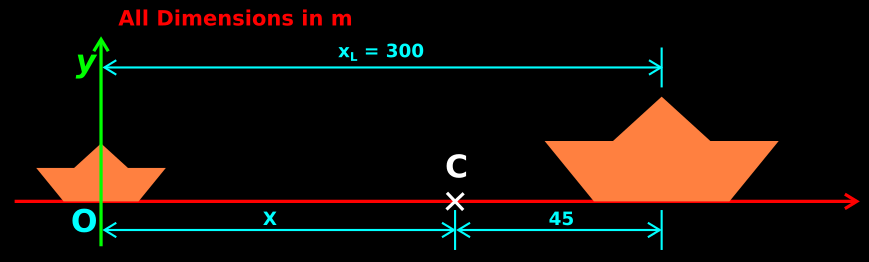
A large boat and a small boat are at rest on the surface of a lake. The distance between the two boats is 300 m. A man in the large boat, begins to pull the small boat towards him using a light inextensible rope. When the small boat reaches him, the large boat has moved 45 m towards the small boat. If the large boat has a mass of 5400 kg, what is the mass of the small boat? Neglect the friction offered by the water
Solution:
1. Given:
• Mass of large boat = mL = 5400 kg
• Initial distance between the two boats = 300 m   
• Final distance between the two boats = 45 m
• We are asked to find the mass of the small boat mS
2. Initial position of the 'C' of the two-boat system can be calculated as follows:
• The 'C' is some where on the line joining the two boats
• Assume that the origin O is at the center of the small boat
• This is shown in fig.7.52 below:
Fig.7.52
• We have: $\mathbf\small{X=\frac{m_S x_S+m_L x_L}{m_S + m_L}}$   
• Substituting the known values, we get: $\mathbf\small{X=\frac{m_S \times 0+5400 \times 300}{m_S + 5400}}$
$\mathbf\small{\Rightarrow X=\frac{1620000}{m_S + 5400}}$
3. When the man pulls the boat, the forces involved are internal
• So there is no external force
• So the velocity of the 'C' does not change
• The 'C' was initially at rest (∵ both boats are initially at rest)
• So the 'C' continues to remain at rest. In other words, there is no change in the position of 'C'
4. Finally, when large boat has traveled 45 m, the two boats touch each other
• When the touching happens, both the boats are at 'C'
• That means, the large boat was initially 45 m away from 'C'
• From the fig.7.52, we get: X = (300-45) = 255 m
5. Substituting this value of X in (2), we get: $\mathbf\small{255=\frac{1620000}{m_S + 5400}}$
• Thus we get: mS = 953 kg

Next we have to learn about angular velocity. For that, first we must be familiar with vector cross products. So we will see that in the next section

PREVIOUS           CONTENTS          NEXT

Copyright©2019 Higher Secondary Physics. blogspot.in - All Rights Reserved

Wednesday, April 17, 2019

Chapter 7.8 - Force Acting on a System of Particles

In the previous section, we saw the velocity and acceleration of the 'C'. In this section we will see it's momentum and force

1. Let a system consist of two particles P and Q
• Let both P and Q be in motion
2. Consider any instant during that motion
• In earlier sections of this chapter, we have seen that, all particles in the system need not be having the same velocity at any instant (Details here)
• So let us assume that, at that instant, P and Q are having different velocities
3. Consider the instant at which the reading in the stop-watch is 't'
    ♦ Let at that instant, the velocity vector of P be $\mathbf\small{\vec{v}_{P(t)}}$
4. If we multiply this velocity by 'mass of P', we will get the momentum of P at that instant
So we can write: $\mathbf\small{\vec{p}_{P(t)}=m_P\,\vec{v}_{P(t)}}$  
5. Similarly, if the velocity of Q at that instant is $\mathbf\small{\vec{v}_{Q(t)}}$, we can write it's momentum:
$\mathbf\small{\vec{p}_{Q(t)}=m_Q\,\vec{v}_{Q(t)}}$
6. Sum of the two momenta will give the 'total momentum of the system'. So we can write:
$\mathbf\small{\vec{p}_{System(t)}=m_P\,\vec{v}_{P(t)}+m_Q\,\vec{v}_{Q(t)}}$
7. In general, if there are n particles, we can write:
$\mathbf\small{\vec{p}_{System(t)}=m_1 \,\, \vec{v}_{1(t)}+m_2 \,\, \vec{v}_{2(t)}+ \,\,.\,\,.\,\,.+m_i \,\, \vec{v}_{i(t)}+\,\,.\,\,.\,\,.+m_n \,\, \vec{v}_{n(t)}}$
8. Consider the right side of the above equation. We have seen it before
• In Eq.7.6 of the previous section, we wrote:
$\mathbf\small{M\,\,\vec{v}_{C(t)}=m_1 \,\, \vec{v}_{1(t)}+m_2 \,\, \vec{v}_{2(t)}+ \,\,.\,\,.\,\,.+m_i \,\, \vec{v}_{i(t)}+\,\,.\,\,.\,\,.+m_n \,\, \vec{v}_{n(t)}}$
9. Comparing (7) and (8), we can write:
Eq.7.11:
$\mathbf\small{\vec{p}_{System(t)}=M\,\,\vec{v}_{C(t)}}$
■ Based on this equation, we can write:
The total momentum of a system of particles is equal to the product of two items:
(i) The total mass of the system
(ii) Velocity of the 'C'

Force on a system

1. Let there be n particles in a system
• Let the system be in motion
2. Consider the instant at which the reading in the stop-watch is 't1'
    ♦ Let at that instant, the total momentum of the system be $\mathbf\small{\vec{p}_{System(t1)}}$
• Consider the instant at which the reading in the stop-watch is 't2'
    ♦ Let at that instant, the total momentum of the system be $\mathbf\small{\vec{p}_{System(t2)}}$
4. If we subtract the 'initial momentum vector' from the 'final momentum vector', we will get the change in momentum
• So we can write:
The 'change in momentum' suffered by the system during the time interval of (t2-t1
= $\mathbf\small{\vec{p}_{System(t2)}-\;\vec{p}_{System(t1)}}$
5. If we divide the 'change in momentum' by the 'time interval during which the change took place', we will get the average force (Details here)
• Time interval during which the displacement took place = (t2-t1) = Δt
• So we can write:
Average force experienced by the system during the time interval Δt =
$\mathbf\small{\vec{\bar{F}}_{System(\Delta t)}=\frac{\vec{\Delta p}_{System(\Delta t)}}{\Delta t}=\frac{\vec{p}_{System(t2)}-\vec{p}_{System(t1)}}{\Delta t}}$
6. Now we expand the numerator on the right side
Using Eq.7.11, we get:
$\mathbf\small{\vec{p}_{System(t2)}=M\,\,\vec{v}_{C(t2)}}$
$\mathbf\small{\vec{p}_{System(t1)}=M\,\,\vec{v}_{C(t1)}}$
• So the result in (5) becomes:
$\mathbf\small{\vec{\bar{F}}_{System(\Delta t)}=\frac{M\,\,\vec{v}_{C(t2)}-M\,\,\vec{v}_{C(t1)}}{\Delta t}}$
$\mathbf\small{\Rightarrow \vec{\bar{F}}_{System(\Delta t)}=\frac{M[\vec{v}_{C(t2)}-\,\,\vec{v}_{C(t1)}]}{\Delta t}}$
$\mathbf\small{\Rightarrow \vec{\bar{F}}_{System(\Delta t)}=M[\vec{a}_{C(\Delta t)}]}$
7. If we consider an interval of time Δt, we will be getting the average force $\mathbf\small{\vec{\bar{F}}_{System(\Delta t)}}$
• If we consider an instant 't', we will get the instantaneous force $\mathbf\small{\vec{F}_{System(t)}}$
• Thus we can write: 
Eq.7.12: $\mathbf\small{\Rightarrow \vec{F}_{System(t)}=M[\vec{a}_{C(t)}]}$
    ♦ Where $\mathbf\small{\vec{a}_{C(t)}}$ is the acceleration experienced by the 'C' at the instant 't'
• This is in a form familiar to us: Force = mass × acceleration 
8. Based on Eq.7.12, we can write:
• The force experienced by a system of particles is equal to the product of two items:
(i) The total mass of the system
(ii) Acceleration of the 'C'
• Thus we succeeded in extending Newton's second law to a 'system of particles'

Conservation of momentum

1. Consider the equation in (5) above. We will write it again:
$\mathbf\small{\vec{\bar{F}}_{System(\Delta t)}=\frac{\vec{p}_{System(t2)}-\vec{p}_{System(t1)}}{\Delta t}}$
• Suppose that, the system experiences no external force. Then $\mathbf\small{\vec{\bar{F}}_{System(\Delta t)}=0}$
• Then the numerator will become zero
• We get: $\mathbf\small{\vec{p}_{System(t2)}-\vec{p}_{System(t1)}=0}$
$\mathbf\small{\Rightarrow \vec{p}_{System(t2)}=\vec{p}_{System(t1)}}$
• That means: Final momentum = Initial momentum  
• That means: There is no change in momentum
• That means: Momentum is a constant
■ Thus we get the law of conservation of momentum for the system of particles. It can be stated as:
If the total external force acting on a system of particles is zero, the total linear momentum of that system is constant
2. But from Eq.7.11, we have: $\mathbf\small{\vec{p}_{System(t)}=M\,\,\vec{v}_{C(t)}}$
• If the left side is constant, the right side must also be constant
• In the right side, we have 'M' and '$\mathbf\small{\vec{v}_{C(t)}}$
• 'M' is already a constant because, we assume that, the mass of the system do not change
■ So we can write:
If the total external force acting on a system of particles is zero, the velocity of the 'C' of that system will be constant
• 'Constant velocity' implies that, both magnitude and direction of the velocity does not change
• So we can write:
If the total external force acting on a system of particles is zero, the 'C' of that system will travel at a constant speed along a straight line

In the next section, we will some examples where the 'C' moves with constant velocity

PREVIOUS           CONTENTS          NEXT

Copyright©2019 Higher Secondary Physics. blogspot.in - All Rights Reserved

Monday, April 15, 2019

Chapter 7.7- Velocity of the Center of mass

In the previous section, we saw the method for finding the location of 'C' of any system of particles. In this section we will see the applications of 'C'

1. Let a system consist of two particles P and Q
• Let both P and Q be in motion
2. Consider any instant during that motion
• In earlier sections of this chapter, we have seen that, all particles in the system need not be having the same velocity at an instant (Details here)
• So let us assume that, at that instant, P and Q are having different velocities
3. Consider the instant at which the reading in the stop-watch is 't1'
    ♦ Let at that instant, the position vector of P be $\mathbf\small{\vec{r}_{P(t1)}}$
• Consider the instant at which the reading in the stop-watch is 't2'
    ♦ Let at that instant, the position vector of P be $\mathbf\small{\vec{r}_{P(t2)}}$
4. If we subtract the 'initial position vector' from the 'final position vector', we will get the displacement (Details here)
• So we can write:
The displacement suffered by 'P' during the time interval of (t2-t1
= $\mathbf\small{\vec{\Delta r}_P=\vec{r}_{P(t2)}-\vec{r}_{P(t1)}}$
5. If we divide the displacement by the 'time interval during which the displacement took place', we will get the average velocity (Details here)
• Time interval during which the displacement took place = (t2-t1) = Δt
• So we can write:
Average velocity with which P traveled during the time interval Δt =
$\mathbf\small{\vec{\bar{v}}_{P(\Delta t)}=\frac{\vec{\Delta r}_P}{\Delta t}=\frac{\vec{r}_{P(t2)}-\vec{r}_{P(t1)}}{\Delta t}}$
$\mathbf\small{\Rightarrow \vec{\bar{v}}_{P(\Delta t)}=\frac{\vec{r}_{P(t2)}}{\Delta t}-\frac{\vec{r}_{P(t1)}}{\Delta t}}$
6. In the same way, we will get:
• Average velocity with which Q traveled during the time interval Δt =
$\mathbf\small{\vec{\bar{v}}_{Q(\Delta t)}=\frac{\vec{r}_{Q(t2)}}{\Delta t}-\frac{\vec{r}_{Q(t1)}}{\Delta t}}$
7. Let us multiply the above velocities with the respective masses and then add
• For particle P, we will get:
$\mathbf\small{m_P \,\, \vec{\bar{v}}_{P(\Delta t)}=\frac{m_P\,\,\vec{r}_{P(t2)}}{\Delta t}-\frac{m_P\,\,\vec{r}_{P(t1)}}{\Delta t}}$
• For particle Q, we will get:
$\mathbf\small{m_Q \,\, \vec{\bar{v}}_{Q(\Delta t)}=\frac{m_Q\,\,\vec{r}_{Q(t2)}}{\Delta t}-\frac{m_Q\,\,\vec{r}_{Q(t1)}}{\Delta t}}$
8. Adding the two, we get:
$\mathbf\small{m_P \,\, \vec{\bar{v}}_{P(\Delta t)}+m_Q \,\, \vec{\bar{v}}_{Q(\Delta t)}}$
$\mathbf\small{=\left[\frac{m_P\,\,\vec{r}_{P(t2)}}{\Delta t}-\frac{m_P\,\,\vec{r}_{P(t1)}}{\Delta t}\right]+\left[\frac{m_Q\,\,\vec{r}_{Q(t2)}}{\Delta t}-\frac{m_Q\,\,\vec{r}_{Q(t1)}}{\Delta t}\right]}$
• Rearranging this, we get:
$\mathbf\small{m_P \,\, \vec{\bar{v}}_{P(\Delta t)}+m_Q \,\, \vec{\bar{v}}_{Q(\Delta t)}}$
$\mathbf\small{=\left[\frac{m_P\,\,\vec{r}_{P(t2)}}{\Delta t}+\frac{m_Q\,\,\vec{r}_{Q(t2)}}{\Delta t}\right]-\left[\frac{m_P\,\,\vec{r}_{P(t1)}}{\Delta t}+\frac{m_Q\,\,\vec{r}_{Q(t1)}}{\Delta t}\right]}$
$\mathbf\small{\Rightarrow m_P \,\, \vec{\bar{v}}_{P(\Delta t)}+m_Q \,\, \vec{\bar{v}}_{Q(\Delta t)}}$
$\mathbf\small{=\left[\frac{m_P\,\,\vec{r}_{P(t2)}+m_Q\,\,\vec{r}_{Q(t2)}}{\Delta t}\right]-\left[\frac{m_P\,\,\vec{r}_{P(t1)}+m_Q\,\,\vec{r}_{Q(t1)}}{\Delta t}\right]}$
9. Consider the 'numerator of the first term' on the right side:
$\mathbf\small{m_P\,\,\vec{r}_{P(t2)}+m_Q\,\,\vec{r}_{Q(t2)}}$
• This is $\mathbf\small{\sum{m_i \vec{r}_{i(t2)}} }$
• That means: 
(i) The position vectors of all the particles at the 'instant when reading of the stop-watch is t2' is taken
(ii) The summation is done using those position vectors
10. But we have Eq.7.4: $\mathbf\small{\vec{r}_C=\frac{\sum{} \,m_i\,\vec{r}_i}{M}}$
• The summation in the numerator of Eq.7.4 is the same summation that we wrote in (9)
11. Now, Eq,7.4 can be written as: $\mathbf\small{M\,\vec{r}_C=\sum{} \,m_i\,\vec{r}_i}$
• So the summation in (9) can be replaced by $\mathbf\small{M\,\vec{r}_{C(t2)}}$
Where $\mathbf\small{\vec{r}_{C(t2)}}$ is the position vector of 'C' at the 'instant when reading of the stop-watch is t2'
12. So the result in (8) will become:
$\mathbf\small{m_P \,\, \vec{\bar{v}}_{P(\Delta t)}+m_Q \,\, \vec{\bar{v}}_{Q(\Delta t)}}$
$\mathbf\small{=\left[\frac{M\,\vec{r}_{C(t2)}}{\Delta t}\right]-\left[\frac{m_P\,\,\vec{r}_{P(t1)}+m_Q\,\,\vec{r}_{Q(t1)}}{\Delta t}\right]}$ 
13. The 'numerator of the second term' on the right side in (12) above, can also be modified in this way. We will get:
$\mathbf\small{m_P \,\, \vec{\bar{v}}_{P(\Delta t)}+m_Q \,\, \vec{\bar{v}}_{Q(\Delta t)}}$
$\mathbf\small{=\left[\frac{M\,\vec{r}_{C(t2)}}{\Delta t}\right]-\left[\frac{M\,\vec{r}_{C(t1)}}{\Delta t}\right]}$
14. This can be rearranged as:
$\mathbf\small{m_P \,\, \vec{\bar{v}}_{P(\Delta t)}+m_Q \,\, \vec{\bar{v}}_{Q(\Delta t)}=\frac{M\,[\vec{r}_{C(t2)}-\vec{r}_{C(t1)}]}{\Delta t}}$
15. But $\mathbf\small{\frac{\,[\vec{r}_{C(t2)}-\vec{r}_{C(t1)}]}{\Delta t}=\vec{\bar{v}}_{C(\Delta t)}}$
• So (13) becomes: $\mathbf\small{m_P \,\, \vec{\bar{v}}_{P(\Delta t)}+m_Q \,\, \vec{\bar{v}}_{Q(\Delta t)}=M\,\,\vec{\bar{v}}_{C(\Delta t)}}$
In general, we can write:
Eq.7.5:
$\mathbf\small{M\,\,\vec{\bar{v}}_{C(\Delta t)}}=m_1 \,\, \vec{\bar{v}}_{1(\Delta t)}+m_2 \,\, \vec{\bar{v}}_{2(\Delta t)}+ \,\,.\,\,.\,\,.+m_i \,\, \vec{\bar{v}}_{i(\Delta t)}+\,\,.\,\,.\,\,.+m_n \,\, \vec{\bar{v}}_{n(\Delta t)}$
16. In the above discussion, we have considered a time interval of Δt, which is equal to (t2-t1)
• If the particles are travelling with non-uniform velocities, division by this Δt will give average velocities
• If this Δt is very small, the division will give instantaneous velocities
• Then the Eq.7.5 will become:
Eq.7.6:
$\mathbf\small{M\,\,\vec{v}_{C(t)}=m_1 \,\, \vec{v}_{1(t)}+m_2 \,\, \vec{v}_{2(t)}+ \,\,.\,\,.\,\,.+m_i \,\, \vec{v}_{i(t)}+\,\,.\,\,.\,\,.+m_n \,\, \vec{v}_{n(t)}}$
• All the velocities in this expression, are instantaneous velocities
• It is the velocity at the instant when the reading in the stop-watch is 't'
17. Eq.7.6 can be written as: $\mathbf\small{M\,\,\vec{v}_{C(t)}=\sum {m_i\;\vec{v}_{i(t)}}}$
• Rearranging this, we get:
Eq.7.7: $\mathbf\small{\vec{v}_{C(t)}=\frac{\sum {m_i\;\vec{v}_{i(t)}}}{M}}$
• This is an effective method to find the velocity with which the 'C' moves 

So we have seen the velocity of the particles in a system. Next we will see acceleration

1. Let a system consist of two particles P and Q
• Let both P and Q be in motion
2. Consider any instant during that motion
• In earlier sections of this chapter, we have seen that, all particles in the system need not be having the same velocity at an instant (Details here)
• So let us assume that, at that instant, P and Q are having different velocities
3. Consider the instant at which the reading in the stop-watch is 't1'
    ♦ Let at that instant, the velocity vector of P be $\mathbf\small{\vec{v}_{P(t1)}}$
• Consider the instant at which the reading in the stop-watch is 't2'
    ♦ Let at that instant, the velocity vector of P be $\mathbf\small{\vec{v}_{P(t2)}}$
4. If we subtract the 'initial velocity vector' from the 'final position vector', we will get the change in velocity 
• So we can write:
The 'change in velocity' suffered by 'P' during the time interval of (t2-t1
= $\mathbf\small{\vec{\Delta v}_P=\vec{v}_{P(t2)}-\vec{v}_{P(t1)}}$
5. If we divide the 'change in velocity' by the 'time interval during which the change took place', we will get the average acceleration (Details here)
• Time interval during which the displacement took place = (t2-t1) = Δt
• So we can write:
Average acceleration with which P traveled during the time interval Δt =
$\mathbf\small{\vec{\bar{a}}_{P(\Delta t)}=\frac{\vec{\Delta v}_P}{\Delta t}=\frac{\vec{v}_{P(t2)}-\vec{v}_{P(t1)}}{\Delta t}}$
$\mathbf\small{\Rightarrow \vec{\bar{a}}_{P(\Delta t)}=\frac{\vec{v}_{P(t2)}}{\Delta t}-\frac{\vec{v}_{P(t1)}}{\Delta t}}$
6. In the same way, we will get:
• Average acceleration with which Q traveled during the time interval Δt =
$\mathbf\small{\vec{\bar{a}}_{Q(\Delta t)}=\frac{\vec{v}_{Q(t2)}}{\Delta t}-\frac{\vec{v}_{Q(t1)}}{\Delta t}}$
7. Let us multiply the above accelerations with the respective masses and then add
• For particle P, we will get:
$\mathbf\small{m_P \,\, \vec{\bar{a}}_{P(\Delta t)}=\frac{m_P\,\,\vec{v}_{P(t2)}}{\Delta t}-\frac{m_P\,\,\vec{v}_{P(t1)}}{\Delta t}}$
• For particle Q, we will get:
$\mathbf\small{m_Q \,\, \vec{\bar{a}}_{Q(\Delta t)}=\frac{m_Q\,\,\vec{v}_{Q(t2)}}{\Delta t}-\frac{m_Q\,\,\vec{v}_{Q(t1)}}{\Delta t}}$
8. Adding the two, we get:
$\mathbf\small{m_P \,\, \vec{\bar{a}}_{P(\Delta t)}+m_Q \,\, \vec{\bar{a}}_{Q(\Delta t)}}$
$\mathbf\small{=\left[\frac{m_P\,\,\vec{v}_{P(t2)}}{\Delta t}-\frac{m_P\,\,\vec{v}_{P(t1)}}{\Delta t}\right]+\left[\frac{m_Q\,\,\vec{v}_{Q(t2)}}{\Delta t}-\frac{m_Q\,\,\vec{v}_{Q(t1)}}{\Delta t}\right]}$
• Rearranging this, we get:
$\mathbf\small{m_P \,\, \vec{\bar{a}}_{P(\Delta t)}+m_Q \,\, \vec{\bar{a}}_{Q(\Delta t)}}$
$\mathbf\small{=\left[\frac{m_P\,\,\vec{v}_{P(t2)}}{\Delta t}+\frac{m_Q\,\,\vec{v}_{Q(t2)}}{\Delta t}\right]-\left[\frac{m_P\,\,\vec{v}_{P(t1)}}{\Delta t}+\frac{m_Q\,\,\vec{v}_{Q(t1)}}{\Delta t}\right]}$
$\mathbf\small{\Rightarrow m_P \,\, \vec{\bar{a}}_{P(\Delta t)}+m_Q \,\, \vec{\bar{a}}_{Q(\Delta t)}}$
$\mathbf\small{=\left[\frac{m_P\,\,\vec{v}_{P(t2)}+m_Q\,\,\vec{v}_{Q(t2)}}{\Delta t}\right]-\left[\frac{m_P\,\,\vec{v}_{P(t1)}+m_Q\,\,\vec{v}_{Q(t1)}}{\Delta t}\right]}$
9. Consider the 'numerator of the first term' on the right side:
$\mathbf\small{m_P\,\,\vec{v}_{P(t2)}+m_Q\,\,\vec{v}_{Q(t2)}}$
• From Eq.7.6, this is $\mathbf\small{M\,\,\vec{v}_{C(t2)}}$
• Similarly, the numerator of the second term on the right side will become:
$\mathbf\small{M\,\,\vec{v}_{C(t1)}}$
10. So the result in (8) will become:
$\mathbf\small{m_P \,\, \vec{\bar{a}}_{P(\Delta t)}+m_Q \,\, \vec{\bar{a}}_{Q(\Delta t)}=\left[\frac{M\,\,\vec{v}_{C(t2)}}{\Delta t}\right]-\left[\frac{M\,\,\vec{v}_{C(t1)}}{\Delta t}\right]}$
$\mathbf\small{\Rightarrow m_P \,\, \vec{\bar{a}}_{P(\Delta t)}+m_Q \,\, \vec{\bar{a}}_{Q(\Delta t)}=M\left[\frac{\vec{v}_{C(t2)}-\vec{v}_{C(t1)}}{\Delta t}\right]}$
$\mathbf\small{\Rightarrow m_P \,\, \vec{\bar{a}}_{P(\Delta t)}+m_Q \,\, \vec{\bar{a}}_{Q(\Delta t)}=M\,\, \vec{\bar{a}}_{C(\Delta t)}}$
11. From Newton's second law, We have:
Force = mass × acceleration
• In our present case, the acceleration is average acceleration. So we can write:
Average force = mass × average acceleration
• Thus the result in (10) becomes:
$\mathbf\small{\vec{\bar{F}}_{P(\Delta t)}+\vec{\bar{F}}_{Q(\Delta t)}=M\,\, \vec{\bar{a}}_{C(\Delta t)}}$
• That means:
Average force acting on particle P Average force acting on particle Q
= [Total mass × Average acceleration of the 'C']
In general we can write:
Eq.7.8:
[Total mass × Average acceleration of the 'C'
$\mathbf\small{\vec{\bar{F}}_{1(\Delta t)}+\vec{\bar{F}}_{2(\Delta t)}+ \,\,.\,\,.\,\,.+\vec{\bar{F}}_{i(\Delta t)}+\,\,.\,\,.\,\,.+\vec{\bar{F}}_{n(\Delta t)}}$
11. In the above discussion, we have considered a time interval of Δt, which is equal to (t2-t1)
• If the particles are travelling with non-uniform velocities, division by this Δt will give average acceleration
• If this Δt is very small, the division will give instantaneous acceleration
• Then the Eq.7.8 will become:
Eq.7.9:
[Total mass × Instantaneous acceleration of the 'C'
$\mathbf\small{\vec{F}_{1(t)}+\vec{F}_{2(t)}+ \,\,.\,\,.\,\,.+\vec{F}_{i(t)}+\,\,.\,\,.\,\,.+\vec{F}_{n(t)}}$
• All the forces in this expression, are instantaneous forces
• It is the force at the instant when the reading in the stop-watch is 't'
So we can write:
The following two quantities are equal:
(i) The product of the 'total mass' and 'acceleration experienced by 'C''
(ii) The vector sum of all the forces acting on the particles in the system
12. Note:
• $\mathbf\small{\vec{F}_{1(t)}}$ is the force acting on 'particle 1' at the instant 't'
• But this force itself is a vector sum
■ Many forces may be acting on 'particle 1'. We must calculate the resultant of all those forces
Like wise:
• $\mathbf\small{\vec{F}_{2(t)}}$ is the force acting on 'particle 2' at the instant 't'
• But this force itself is a vector sum
■ Many forces may be acting on 'particle 2'. We must calculate the resultant of all those forces
• Like wise, we can write for all other particles also
13. This leads us to an interesting result. It can be explained with the help of an example:
(i) A system consists of 2 particles P and Q
• Forces acting on P are: $\mathbf\small{\vec{F}_{P1},\,\vec{F}_{P2}\, \text{and}\,\vec{F}_{P3}}$
• In addition to the above forces, the particle Q also exerts a force on P. This force is $\mathbf\small{\vec{F}_{PQ}}$
    ♦ This force can be considered as an internal force
    ♦ Because it is exerted between particles inside the system
• So the net force acting on P is: $\mathbf\small{\vec{F}_{P1}+\vec{F}_{P2}+\vec{F}_{P3}+\vec{F}_{PQ}}$
(ii) Forces acting on Q are: $\mathbf\small{\vec{F}_{Q1},\,\vec{F}_{Q2}\, \text{and}\,\vec{F}_{Q3}}$
• In addition to the above forces, the particle P also exerts a force on Q. This force is $\mathbf\small{\vec{F}_{QP}}$
    ♦ This force can be considered as an internal force
    ♦ Because it is exerted between particles inside the system
• So the net force acting on Q is: $\mathbf\small{\vec{F}_{Q1}+\vec{F}_{Q2}+\vec{F}_{Q3}+\vec{F}_{QP}}$
(iii) Once we know all the forces acting on each particles, we can apply Eq.7.9
We get:
[mP+mQ× Acceleration of the 'C'] = $\mathbf\small{(\vec{F}_{P1}+\vec{F}_{P2}+\vec{F}_{P3}+\vec{F}_{PQ})+(\vec{F}_{Q1}+\vec{F}_{Q2}+\vec{F}_{Q3}+\vec{F}_{QP})}$
(iv) But according to Newton's third law, $\mathbf\small{\vec{F}_{PQ}=-\vec{F}_{QP}}$
• So those two internal forces will cancel each other
• Thus we get:
[mP+mQ× Acceleration of the 'C'] = $\mathbf\small{(\vec{F}_{P1}+\vec{F}_{P2}+\vec{F}_{P3})+(\vec{F}_{Q1}+\vec{F}_{Q2}+\vec{F}_{Q3})}$
■ That means, while applying Eqs.7.8 and 7.9, internal forces in the system have no role to play
14. Consider all the external forces acting on the particles of a system
• Let us denote the vector sum of all the external forces as $\mathbf\small{\vec{F}_{ext}}$
• Also let us denote acceleration of the 'C' as $\mathbf\small{\vec{A}_C}$  
• Then Eq.7.9 becomes:
Eq.7.10: $\mathbf\small{\text{M}\;\vec{A}_C=\vec{F}_{ext}}$
• On the left side, we have: Total mass multiplied by the acceleration experienced by 'C'
• On the right side, we have the vector sum of all external forces acting on the system. That is., the net external force
■ So we can write:
• The net external force will produce the following effect:
Movement of the 'C' with an acceleration, as if, all the mass of the system is concentrated at the 'C' 
• This is the reason why, in the previous chapters, we were able to do problems by considering, wooden blocks, cars, trucks etc., as 'point masses'
16. It may be noted that, if the net force is not acting at 'C', the system will rotate
• We did not consider any rotational motions of objects in the previous chapters
• There was no reason to consider rotation because, we assumed that the net force acts at the 'C'

A practical example:
1. Consider a projectile shown in fig.7.45(a) below:
The center of mass of a projectile remains the same even after an explosion because, total external forces acting on the system remains the same.
Fig.7.45
• We know that, it's path will be a parabola
    ♦ This is indicated by the yellow curve
2. At point 'A', the projectile is intact
• But when it reaches point 'B', it explodes into two pieces 
• Let us call them 'Part P' and 'Part Q'
3. We know that, the only force acting on a projectile is the 'gravitational force'
• This force acts vertically
• There is no horizontal force (Details here)
4. Let us assume that, at the time of launch, P and Q were glued together
• This is shown in fig.b
• The glued combination will have a definite 'C'
    ♦ A force of (mP × g) acts on P
    ♦ A force of (mQ × g)  acts on Q
• The glued combination moves as if [(mP × g)+(mQ × g)] is acting at 'C' of the combination
5. The combination explodes when it reaches B
(The explosion may be due to the 'ignition of some explosives' kept at the interface between P and Q)
• Beyond B, the parts P and Q move as a system
• Beyond B:
    ♦ the force acting on P is (mP × g) 
    ♦ the force acting on Q is (mQ × g)
• So we see that, the forces acting on each part remains the same even after collision
6. P will change course because a force due to explosion is exerted on it
• Q will also change course because a force due to explosion is exerted on it
• But those forces are internal forces and have no contribution on the net force
7. The only external forces are:
• (mP × g) acting on P
• (mQ × g)acting on Q
• These forces remain the same before and after the explosion
■ So force acting at 'C' remains the same before and after the explosion
■ Since there is no change in the external force, the  force acting at 'C', does not change
■ So the course of 'C' will not change
■ That means, the location of 'C' will continue as if no explosion have occurred
The following solved example will make this point clear:

Solved example 7.8
A projectile explodes into two pieces P and Q. The explosion occurred at the top most point of it's trajectory. The horizontal distance between the 'launch point' and the 'point of explosion' is x0. The larger piece Q has 3 times the mass of the smaller piece P. The smaller piece P lands back at the launch point. 
(a) Where does the 'C' of the system land ?
(b) Where does 'Q' land?
Solution:
1. The 'C' of the projectile always lands at a distance of 'R' from the launch point
This is shown in fig.7.46(a) below:
Fig.7.46
• Even if an explosion occur, the 'C' of the fragments will land at the same point
This is shown in fig.b
2. Given that, the explosion occurred at a horizontal distance of x0 from the launch point
• Also given that, the explosion occurred at the top of the trajectory
3. The top of a parabolic trajectory is at a horizontal distance of $\mathbf\small{\frac{R}{2}}$ from the launch point
• Thus we get: $\mathbf\small{x_0=\frac{R}{2}}$
$\mathbf\small{\Rightarrow R=2x_0}$
• This is the answer for part (a)
4. Now we have the final position of 'C'
• We are given the final position of one of the pieces:
The smaller piece P lands back at the launch point
(The path followed by P is shown as the green dashed curve in fig.c)
5. So we have the position of 'C'
• And we have the position of one of the pieces
6. The position of 'C' is given by: $\mathbf\small{X=\frac{\sum m_i x_i}{M}}$
• To apply this formula, we want a reference frame
• The reference frame shown in fig.7.46 is that of the projectile
• We will use it for 'C' also
• Thus we have:
    ♦ X = R = 2x0
    ♦ m1 = mP
    ♦ m2 = mQ = 3mP
    ♦ x1 = xP = 0
    ♦ x2 = xQ = ? (The path followed by Q is shown as the red dashed curve in fig.c)
    ♦ M = mP + mQ = 4mP
• Substituting these values, we get:
$\mathbf\small{2x_0=\frac{m_P\,x_P+m_Q\,x_Q}{m_P+m_Q}=\frac{m_P\times 0+3m_P\,x_Q}{4m_P}=\frac{3}{4}x_Q}$
$\mathbf\small{\Rightarrow x_Q=\frac{8}{3}x_0}$
• This is the answer for part (b)

So we have seen velocity and force on a system of particles. In the next section, we will see momentum

PREVIOUS           CONTENTS          NEXT

Copyright©2019 Higher Secondary Physics. blogspot.in - All Rights Reserved