Showing posts with label internal energy. Show all posts

Friday, March 19, 2021

Chapter 12.11 - Solved Examples in Thermodynamics

In the previous section, we saw the second law of thermodynamics applied to heat engine and refrigerator. In this section, we will see some solved examples related to the topics that we saw in this chapter

Solved example 12.11
A geyser heats water flowing at the rate of 3.0 liters per minute from 27 °C to 77 °C. If the geyser operates on a gas burner, what is the rate of consumption of the fuel if its heat of combustion is 4.0 × 10⁴ J/g ?
Solution:
1. Volume of water heated in one minute = 3 liter
2. So mass of water heated in one minute = [3(l)  × 1000 (g l-1)] = 3000 g = 3.0 kg
3. Heat absorbed in one minute =
Mass in one minute × Specific heat capacity × Change in temperature
4. Specific heat capacity of water = 4180 J kg-1 K-1
5. Change in temperature = (77 - 27) = 50 °C
6. Substituting the known values in (3),we get:
Heat absorbed in one minute =
3.0 (kg) × 4180 (J kg-1 K-1 ) × 50 K = 627000 J
7. Given that, one gram of the fuel gives 4.0 × 10⁴ J
So number of grams of fuel required in one minute
= 627000 (J) ÷ 4.0 × 10⁴ (J g-1) = 15.7 g

Solved example 12.12
What amount of heat must be supplied to 2.0 × 10⁻² kg of nitrogen (at room
temperature) to raise its temperature by 45 °C at constant pressure ? (Molecular
mass of N2 = 28 g; R = 8.3 J mol-1 K-1)
Solution:
Method 1:
1. We have: Heat required =
Mass × Specific heat capacity × Change in temperature
2. Mass of nitrogen = 2.0 × 10⁻² kg
3. From data book, we get:
Specific heat capacity of nitrogen (at constant pressure, cp) = 1040 J kg-1 K-1
4. Change in temperature = 45 °C
5. Substituting the known values in (1),we get:
Heat required =
2.0 × 10⁻² (kg) × 1040 (J kg-1 K-1 ) × 45 (K) = 936 J

Method 2:
1. We have: Heat required =
Number of moles × Molar heat capacity × Change in temperature
2. Mass of nitrogen = 2.0 × 10⁻² kg
• Molar mass of N2 = 28 gram
    ♦ So number of moles of N2 in 2.0 × 10⁻² kg
          = [2.0 × 10⁻² (kg) ÷ 28 × 10-3 (kg)] = 0.714 
3. For a diatomic gas, we have:
Molar heat capacity (at constant pressure, cp) = 72 R (We will derive this relation in the next chapter)
• Substituting for R, we get: cp = [72 × 8.3 (J mol-1 K-1)] =
4. Change in temperature = 45 °C
5. Substituting the known values in (1),we get:
Heat required =
0.714 (mol) × [72 × 8.3 (J mol-1 K-1)] × 45 (K) = 933.3 J

Solved example 12.13
A cylinder with a movable piston contains 3 moles of hydrogen at standard temperature and pressure. The walls of the cylinder are made of a heat insulator, and the piston is insulated by having a pile of sand on it. By what factor does the pressure of the gas increase if the gas is compressed to half its original volume ?
Solution:
1. From the description it is clear that, it is an adiabatic process
• We have the relation for adiabatic process: $\mathbf\small{\rm{P_1 V_1^\gamma = P_1 V_2^\gamma}}$
• For a diatomic gas, $\mathbf\small{\rm{\gamma}}$ = 1.4
2. Given that initially, the gas is at STP
    ♦ So P1 = 1 atm
• One mole of any ideal gas will occupy 22.4 L at STP
    ♦ So V1 = (3 × 22.4) L
3. Given that the gas is compressed to half it's original volume
    ♦ So V2 = 0.5V1
4. Substituting the known values in (1), we get:
$\mathbf\small{\rm{1 \; (atm) \times (3 \times 22.4 \; (L))^{1.4} = P_2 \times (0.5 \times 3 \times 22.4 \; (L))^{1.4}}}$
⇒ P2 = 2.64 × P1

Solved example 12.14
In changing the state of a gas adiabatically from an equilibrium state A to another
equilibrium state B, an amount of work equal to 22.3 J is done on the system. If the gas is taken from state A to B via a process in which the net heat absorbed by the system is 9.35 cal, how much is the net work done by the system in the latter case ? (Take 1 cal = 4.19 J)
Solution:
• There are two processes in this problem
    ♦ The first process is an adiabatic process
    ♦ The second process is not adiabatic
1. Let A and B be the initial and final states of the gas. Let W1 be the work done
• For any thermodynamic process, we have: UB = UA + Q - W
• For the first process,
Q = 0 and W1 is positive (since work is done on the gas)
• Thus we get: UB = (UA + W1) = (UA + 22.3 J)
⇒ UB - UA = 22.3 J
2. For the second process, we have:
UB = UA + (9.35 × 4.19) - W2
(Here W2 is negative because, work is done by the gas)
⇒ UB - UA = (9.35 × 4.19 J) - W2
3. What ever be the process, UA and UB will be the same
• So (UA - UB) will also be the same
• Equating the results in (1) and (2), we get:
UB - UA = 22.3 J = (9.35 × 4.19 J) - W2
⇒ W2 = [(9.35 × 4.19 J) - 22.3] = 16.9 J

Solved example 12.15
Two cylinders A and B of equal capacity are connected to each other via a stopcock. A contains a gas at standard temperature and pressure. B is completely evacuated. The entire system is thermally insulated. The stopcock is suddenly opened. Answer the following :
(a) What is the final pressure of the gas in A and B ?
(b) What is the change in internal energy of the gas ?
(c) What is the change in the temperature of the gas ?
(d) Do the intermediate states of the system (before settling to the final equilibrium state) lie on its P-V-T surface ?
Solution:
• For an ideal gas, we have: $\mathbf\small{\rm{\frac{P_1 V_1}{T_1} = \frac{P_2 V_2}{T_2}}}$
• For our present problem, it is given that the entire system is thermally insulated
    ♦ So no heat will enter or leave the system
Part (c): Cylinder B is initially a vacuum
• The gas in A, expands and fills into B. For this, no work is necessary because, the gas is expanding against vacuum
• Since no work is done on/by the gas, the temperature remains the same
    ♦ That is., T1 = T2
    ♦ So change in temperature = (T2 - T1) = 0
Part (a):
• Since T1 = T2, we get: P1V1 = P2V2
• Given that:
    ♦ P1 = 1 atm and V1 = V2
    ♦ So final volume available = 2V1
• So we get: 1 × V1 = P2 × 2V1
⇒ P2 = 0.5 atm
Part (b):
• Since work done is zero and heat exchange is also zero, there will be no change in internal energy
• That is., change in internal energy = 0
Part (d):
• This is a rapid process
• The intermediate P and V values will be fluctuating
• So those values will not lie on the P-V-T surface
(see fig.12.4 in the first section of this chapter)

Solved example 12.16
A steam engine delivers 5.4×10⁸ J of work per minute and services 3.6 × 10⁹ J of heat per minute from its boiler. What is the efficiency of the engine? How much heat is wasted per minute?
Solution:
Part (a):
• Efficiency is given by: $\mathbf\small{\rm{\eta = \frac{Output}{Input}}}$
• Substituting the values, we get:
$\mathbf\small{\rm{\eta = \frac{5.4 \times 10^8 (J)}{3.6 \times 10^9 (J)}}}$ = 0.15 = 15%
Part (b):
Energy wasted = [Input energy - Output work]
= [3.6 × 10⁹ - 5.4×10⁸] = 30.6 ×10⁸ J   

Solved example 12.17
An electric heater supplies heat to a system at a rate of 100 W. If system performs
work at a rate of 75 joules per second. At what rate is the internal energy increasing?
Solution:
1. 100 W is 100 J s-1
• So energy absorbed by the system in one second, Q = 100 J
2. Work done by the system in one second = 75 J
3. We can write: UB = UA + 100 J - 75 J
• Work is given a negative sign because, it is done by the system
4. Thus we get:
Change in internal energy in one second
= (UB - UA) = (100 - 75) = 25 J

Solved example 12.18
A thermodynamic system is taken from an original state to an intermediate state by the linear process shown in Fig. (12.25). Its volume is then reduced to the original value from E to F by an isobaric process. Calculate the total work done by the gas from D to E to F

Internal energy of a system does not depend on the path.
Fig.12.25

Solution:
1. In the initial process, work is done by the gas while expanding from VD to VE
• This work will be equal to:
The area between segment DE and the x-axis
2. In the second process, work is done on the gas while compressing it from VE to VF
• This work is equal to:
The area between segment EF and x-axis
3. So the net work done by the gas is equal to:
The area of the triangle DEF
   ♦ Base of the triangle = (5 - 2) = 3
   ♦ Altitude of the triangle = (600 - 300) = 300
   ♦ So area of the triangle = 12 × 3 (m3) × 300 (N m-2) = 450 J


In the next chapter, we will see kinetic theory


Previous

Contents

Next


Copyright©2021 Higher secondary physics.blogspot.com

Thursday, January 7, 2021

Chapter 12.1 - The First Law of Thermodynamics

In the previous section we saw quasi static process and reversible process. In this section, we will see the first law of thermodynamics.

First we will see internal energy U. It can be explained in 4 steps:
1. Consider the gas inside the cylinder that we saw in the previous section. It is shown again in fig.12.5 below:

Fig.12.5


The molecules of the gas will be always in motion.
    ♦ Due to the motion, molecules will be having kinetic energies.
The molecules will be colliding with each other.
    ♦ So their velocities will always be changing.
    ♦ So kinetic energies will also be changing.
2. But for our present discussion, such changes in kinetic energies does not matter.
What is important is this:
    ♦ Each molecule will be having some amount of kinetic energy.
In addition to kinetic energies, the molecules will be having:
    ♦ Potential Energy.
    ♦
Energy due to vibratory motions.
    ♦ Energy due to rotational motions.
3. We take the sum of all the above four types of energies of all the molecules in the cylinder.
This sum is equal to the internal energy of the gas
    ♦ It is represented using the letter U
4. An important note:
    ♦ The 'cylinder containing the gas' may be placed in a moving vehicle.
    ♦ So the cylinder will be moving.
    ♦ As a result, the cylinder will have some kinetic energy.
The kinetic energy acquired by the motion of the cylinder is not taken into account in the calculations related to the U of the gas.


Now we can learn about the first law of thermodynamics. It can be written in 15 steps:
1. We have seen the basic details about U. There are various methods to calculate the exact value of U. We will see them in higher classes.
In scientific and engineering problems, we are more interested in calculating ΔU, which is the change in internal energy.
2. Suppose that:
    ♦ Ui is the initial internal energy of the gas.
    ♦ Uf is the final internal energy of the gas.
Then we have: ΔU = Uf – Ui
This ΔU can be determined easily by applying the first law of thermodynamics
    ♦ The following steps from (3) to (7) explains how this is done:
3. Suppose that, the gas in the cylinder has an initial internal energy of Ui joules.
Let the gas be heated. Let Q joules of energy flow into the gas.
4. When the gas is heated, it will expand and push the piston upwards.
Since the piston is moved upwards, we can say:
    ♦ Gas is doing work on the piston.
Let the gas do a work of W joules.
5. Now, when the gas acquires Q joules of heat, it’s total internal energy becomes (Ui + Q)
6. But when the gas does work, it loses some energy.
    ♦ In our present case, W joules will be lost.
7. So the total internal energy becomes Ui + Q – W
So we can write: Final internal energy, Uf = Ui + Q – W
So ΔU = [Uf – Ui] = [(Ui + Q – W) – Ui] = Q – W
Thus we get an equation:
Eq.12.1: ΔU = Q – W
This is the mathematical form of the first law of thermodynamics.
The law states that:
The change in internal energy of a system ΔU is the difference between heat supplied to the gas and the work done by the gas.
(In our present case, 'all the molecules of the gas in the cylinder' is the ‘system’)
8. The flow of heat Q into the system can be achieved by any one of the four ways:
    ♦ Place a burner below the cylinder.
    ♦ Place the cylinder in contact with a hot body.
    ♦ Immerse the cylinder in boiling water.
    ♦ Ignite the gas (if the gas is combustible) using an electric circuit.
9. Flow of heat Q out of the system can also be achieved easily:
    ♦ Immerse the cylinder in a box of ice.
10. We have to pay special attention to the signs of each of the three items: ΔU, Q and W
The following steps from (11) to (15) explain this:
11. Suppose that Q1 joules of heat flowed into the gas
But after some time Q2 joules of heat flowed out of the gas.
Then the net heat is the difference between Q1 and Q2
That is., ΔQ = Q1 – Q2
12. Q1 being larger or smaller:
If Q1 is larger, we can say: The gas has a net heat gain.
    ♦ Because, more heat flowed in and less heat flowed out.
    ♦ Mathematically, [ΔQ = (Q1 – Q2)] will be positive.
    ♦ So we can use a positive value of Q in Eq.12.1
If Q1 is smaller, we can say: The gas has a net heat loss.
    ♦ Because, less heat flowed in and more heat flowed out.
    ♦ Mathematically, [ΔQ = (Q1 – Q2)] will be negative.
    ♦ Then we must use the negative value of Q in Eq.12.1
13. Similar steps can be written for work also.
Suppose that W1 joules of work was done by the gas.
But after some time W2 joules of work was done on the gas.
Then the net work is the difference between W1 and W2
That is., ΔW = W1 – W2
14. W1 being larger or smaller:
If W1 is larger, we can say: The gas does a net work.
    ♦ Because, more work is done by the gas and less work was done on the gas.
    ♦ Mathematically, [ΔW = (W1 – W2)] will be positive.
    ♦ So we can use a positive value of W in Eq.12.1
    ♦ But in the equation, a -ve sign is already present before W.
    ♦ So the positive work will be deducted:
          ✰
ΔU = Q - (+W) = Q - W
If W1 is smaller, we can say: The gas has a net work done on it.
    ♦ Because, less work is done by the gas and more work is done on the gas.
    ♦ Mathematically, [ΔW = (W1 – W2)] will be negative.
    ♦ Then we must use the negative value of W in Eq.12.1
    ♦ But in the equation, a -ve sign is already present before W.
   ♦
So the positive work will be added:
          ✰
ΔU = Q - (-W) = Q + W
This is obvious because, a ‘net work done on the gas’ will surely increase the internal energy of the gas.
15. We must have a clear understanding about the above sign convention.
However, while doing problems, it is better to ‘consider the effects’ rather than just following the sign convention.
We can ‘consider the effects’ as follows:
    ♦ A net gain of heat will increase the internal energy of the gas.
    ♦ A net loss of heat will decrease the internal energy of the gas.
    ♦ A net work done by the gas will decrease the internal energy of the gas.
    ♦ A net work done on the gas will increase the internal energy of the gas.

The following two solved examples demonstrate the facts written in (15):
Solved example 12.1
Express the change in internal energy of the system when
(i) No heat is absorbed by the system from the surroundings, but work of W joules is done on the system
(ii) No work is done on the system, but Q joules of heat is taken out from the system and given to the surroundings
(iii)  W joules of work is done by the system and Q joules of heat is supplied to the system
Solution:
Part (i):
Heat is zero.
Work, W is done on the system.
    ♦ This W will cause an increase the internal energy, U. So Uf = Ui + W
Thus we get: ΔU = [Uf - Ui] = [(Ui + W) - Ui] = W
Part (ii):
Work is zero.
Heat, Q is taken out from the system.
    ♦ So this Q will cause a decrease in U. So Uf = Ui - Q
Thus we get: ΔU = [Uf - Ui] = [(Ui - Q) - Ui] = -Q
Part (iii):
Work, W is done by the system.
    ♦ This W will cause a decrease in U.
Heat Q is supplied to the system.
    ♦ This Q will cause an increase in U.
So Uf = Ui - W + Q
Thus we get: ΔU = [Uf - Ui] = [(Ui - W + Q) - Ui] = Q - W

Solved example 12.2
In a thermodynamic process, 40 J of heat is supplied to the system. When this heat is supplied, the system does 10 J of work. After some time, 4 J of work is done on the system. When this work is done, 25 J of heat is released from the system into the surroundings. What is the change in internal energy of the system after the whole process?
Solution:
Stage (1):
Heat of 40 J is supplied to the system.
    ♦ This heat will cause an increase in U.
Work of 10 J is done by the system.
    ♦ This W will cause a decrease in U.
So Uf at the end of stage 1 = Uf(1) = (Ui + 40 - 10) = Ui + 30
    ♦ This Uf(1) is the Ui for stage 2.
Stage 2:
Work of 4 J is done on the system.
    ♦ This W will cause an increase in U.
Heat of 25 J is released from the system.
    ♦ This Q will cause a decrease in U.
So Uf at the end of stage 2 = Uf(2) = (Uf(1) + 4 - 25) = (Uf(1) - 21)
= (Ui + 30 - 21) = Ui + 9
Net change in U at the end of the two stages:
ΔU = (Uf(2) - Ui) = (Ui + 9 - Ui) = 9 J


Next, we will see the relation between the following three items:
Internal internal energy U, temperature T and heat Q. It can be written in 3 steps:
1. Experiments show that, the temperature T is directly proportional to the internal energy U of the gas. That is., T ∝ U
• So, if Ui is the initial internal energy and Ti is the initial temperature, we can write: TiUi
• Similarly, if Uf is the final internal energy and Tf is the final temperature, we can write: TfUf
2. The temperature of the gas can change from Ti to Tf,
    ♦ even if zero Q is added to the system.
    ♦ even if zero Q is taken away from the system.
• We can prove this in 4 steps:
(i) Let a work of W joules be done on the gas.
(ii) Let Q be equal to zero. That is., no heat is supplied or taken away.
(iii) Then we have: Uf = Ui + W
So clearly, Uf is greater than Ui
(iv) From (1), we have: Ti ∝ Ui and TfUf
So, since Uf is greater than Ui, Tf will be greater than Ti
3. So we see that, it is not necessary for a heat-flow (either inwards or outwards) to change the temperature.


In the previous section, we have seen the details about P-V Diagram.
Let us see how the three quantities (ΔU, Q and W) are related to the P-V diagram. It can be written in 5 steps:
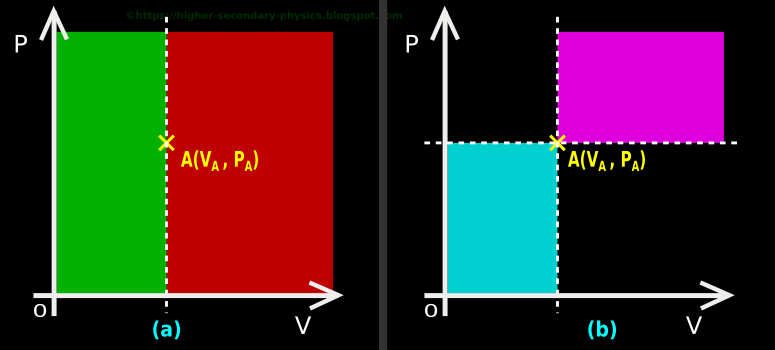
1. Fig.12.6(a) below shows a P-V Diagram.
    ♦ It is the diagram related to the gas in fig.12.5 above.
The initial state of the gas is marked as A(VA, PA)
The final state B(VB, PB) can be any where on the diagram.
    ♦ Position of B will depend on the heat content Q and work content W.

Fig.12.6

2. Draw a vertical dashed line through A.
    ♦ The portion to the right of the vertical dashed line is shaded with red color.
    ♦ The portion to the left of the vertical dashed line is shaded with green color.
3. Sign of work W:
This can be determined in 2 steps:
(i)
If B is any where in the red region, VB will be greater than VA
    ♦ That means, the volume has increased.
    ♦ That means, gas has done work on the piston.
    ♦ Let this work be W.
    ♦ So considering the sign, it will be: – W
(ii) If B is any where in the green region, VB will be less than VA
    ♦ That means, the volume has decreased.
    ♦ That means, work has been done on the gas.
    ♦ Let this work be W.
    ♦ So considering the sign, it will be: + W
4. Sign of ΔU:
This can be determined in 9 steps:
(i) Let the gas in cylinder in fig.12.5 be an ideal gas.
Consider the ideal gas equation: PV = nRT
If there is no leakage of gas in fig.12.5, n will be a constant.
We know that R is always a constant.
So we can write: PV ∝ T
(ii) We have seen that, the temperature T is proportional to the internal energy U.
That means:
    ♦ An increase in T is an indication that U has increased.
    ♦ A decrease in T is an indication that U has decreased.
(iii) But from (i),
    ♦ An increase in T is an indication that PV has increased.
    ♦ A decrease in T is an indication that PV has decreased.
(iv) So it is clear that:
    ♦ An increase in PV is an indication that U has increased.
    ♦ A decrease in PV is an indication that U has decreased.
(v) Draw vertical and horizontal dashed lines through A.
Those lines will divide the graph into four portions.
    ♦ The top right portion is shaded with magenta color.
    ♦ The bottom left portion is shaded with cyan color.
    ♦ This is shown in fig.12.6(b) above.
(vi) If B is in the magenta portion,
    ♦ PB will be greater than PA
    ♦ VB will be greater than VA
Then,
    ♦ PBVB will be greater than PAVA
    ♦ That means, PV value has increased.
If there is an increase in PV, we know that Uf will be greater than Ui
    ♦ So [ΔU = (Uf – Ui)] will be positive.
(vii) If B is in the cyan portion,
    ♦ PB will be less than PA
    ♦ VB will be less than VA
Then,
    ♦ PBVB will be less than PAVA
    ♦ That means, PV value has decreased.
If there is a decrease in PV, we know that Uf will be less than Ui
    ♦ So [ΔU = (Uf – Ui)] will be negative.
(viii) If B is in the black portion at top left,
    ♦ PB will be greater than PA
    ♦ VB will be less than VA
Then we cannot say which one of (PAVA) and (PBVB) is larger.
In this situation, we will need to pick the actual PA, VA, PB  and VB values from the graph.
Here an interesting situation can arise:
    ♦ Suppose that, PB = 2PA and VB = 0.5VA
    ♦ Then PBVB = (2PA × 0.5VA) = PAVA
    ♦ That means, PV value at B is same as that at A.
    ♦ In such a situation, Uf will be same as Ui.
    ♦ So ΔU will be zero.
(ix) If B is in the black portion at bottom right,
    ♦ PB will be less than PA
    ♦ VB will be greater than VA
Then we cannot say which one of (PAVA) and (PBVB) is larger.
In this situation also, we will need to pick the actual PA, VA, PB  and VB values from the graph.
5. So from the above four steps, we can determine the sign of W and ΔU.
Once we know the sign of those two items, we can find the sign of Q
The following solved example will demonstrate the procedure.

Solved example 12.3
In a thermodynamic process, B is in the cyan region in fig.12.6(b) above. What will be the signs of ΔU, W and Q.
Solution:
1. B is in the cyan region.
    ♦ So B is at the left side of A.
    ♦ So VB is less than VA
That means, work is done on the gas.
    ♦ So it is a positive value.
2. B is in the cyan region.
    ♦ So PV has decreased.
So Uf is less than Ui
    ♦ So [ΔU = (Uf – Ui)] will be negative.
3. We have: Uf – Ui = Q + W
    ♦ From (2), we have: The left side is -ve.
    ♦ From (1), W is positive.
So we get: (-) = Q + (+)
(-) + (-) = Q
So the sign of Q is negative.
That means, Q has flowed out of the gas.


In the next section, we will see the method to calculate the work done during a thermodynamic process.


PREVIOUS

CONTENTS

NEXT

Copyright©2020 Higher Secondary Physics. blogspot.in - All Rights Reserved